Deep Learning and Optimization Approaches in Parkinson's Disease Recognition Via Heterogeneous Split Attention-Based EEG and Siamese Graph Convolutional Attention Network: A Review
DOI:
https://doi.org/10.65521/ijacte.v12i2.3822Keywords:
Abstract
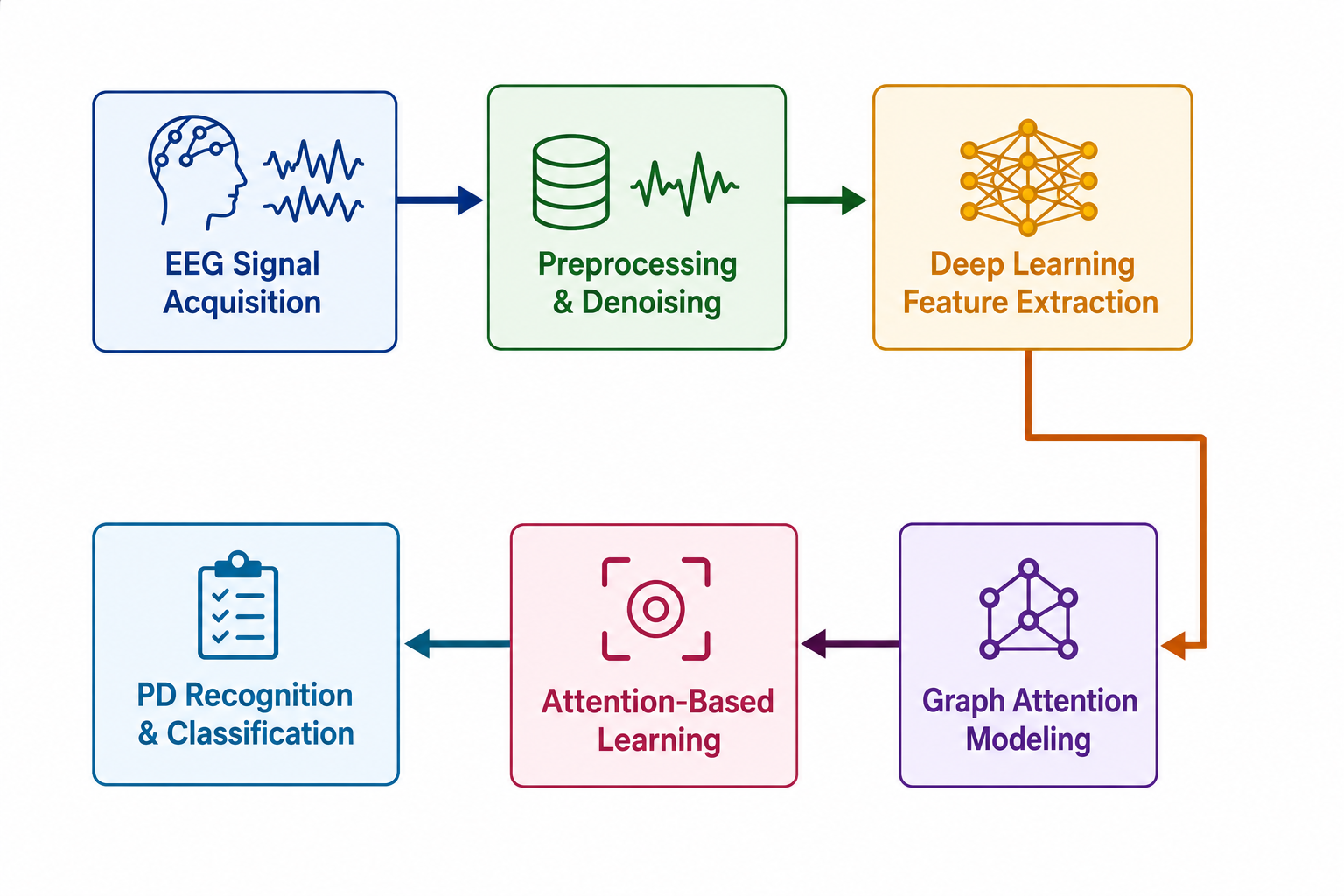
Parkinson’s Disease (PD) is a progressive neurodegenerative disorder that significantly affects motor and cognitive functions. Early detection is crucial for improving patient outcomes; however, conventional diagnostic techniques often fail to identify subtle early-stage symptoms. In recent years, deep learning and optimization-based approaches have shown promising potential in enhancing PD diagnosis using electroencephalography (EEG) signals. EEG provides a non-invasive and cost-effective method for capturing brain activity, enabling the detection of abnormal neural patterns associated with PD. Advanced models such as Convolutional Neural Networks (CNN), Recurrent Neural Networks (RNN), Graph Neural Networks (GNN), and attention-based architectures have been widely adopted for feature extraction and classification. Hybrid approaches combining CNN and LSTM have demonstrated improved performance by capturing spatial and temporal features simultaneously. Furthermore, graph-based models effectively represent functional connectivity among EEG channels, enhancing classification accuracy. Recent developments include Siamese networks and transformer-based architectures that improve generalization and handle limited datasets. Optimization techniques further enhance model performance through feature selection and hyperparameter tuning. Despite significant advancements, challenges such as data scarcity, model interpretability, and computational complexity remain. This review provides a comprehensive analysis of deep learning and optimization techniques for PD recognition and highlights future research directions focusing on heterogeneous split-attention and Siamese graph convolutional attention networks.