
Analysing Bias and Reliability in Soil – Based Crop Recommendation Systems
DOI:
https://doi.org/10.65521/ijacte.v15i2.3865Keywords:
Abstract
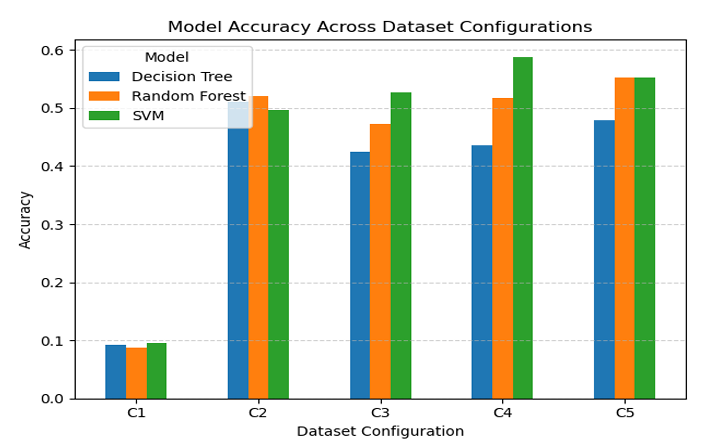
Machine Learning (ML) is now being used for the development of soil-based crop recommendations that support agricultural decision-making. Many of these systems claim to have very high predictive accuracy, however, very little attention has been paid to the effect of data bias and the quality of recommendations. This research study investigates the influence of data bias and how it relates to the reliability of the recommendations when evaluating the performance of ML models. The research utilizes a soil health data collection consisting of nutrient levels, moisture, humidity, temperature, and crop labels to conduct controlled experiments on the relationship between the features and accuracy/stability of predictions by multiple ML models. The experiments were performed by conducting several controlled experiments using the soil health data collection and tracking the effects of different variations of crops selected for training/testing the models, as well as the number of features being used to create the models. The results show that accuracy ratings can vary considerably between datasets as well as dominant features, suggesting potential bias in how models behave. Therefore, it is necessary to conduct comprehensive dataset analysis and create and use evaluation methods that consider the accuracy of models when making recommendations.
Downloads
Published
How to Cite
Issue
Section
License

This work is licensed under a Creative Commons Attribution-NoDerivatives 4.0 International License.
