
Network Traffic Analyzer: Real-Time Detection and Malicious Activity Identification
DOI:
https://doi.org/10.65521/ijacte.v15i1.3819Keywords:
Abstract
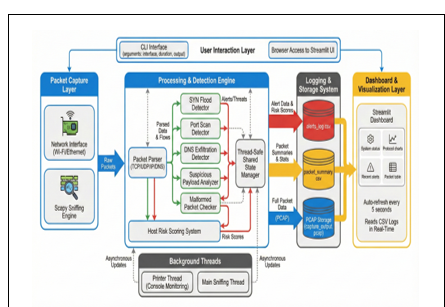
The design and implementation of a real-time net- work traffic analyzer that uses heuristic-driven analysis and live packet inspection for identifying malicious traffic are discussed in this research paper. The Scapy framework is used in the Python coding of the system’s backend to enable continuous packet capture and processing with minimum overhead. As a way to identify abnormal behaviors such TCP SYN flooding, port scanning, suspicious DNS queries, sensitive payload content, and malformed packets, network traffic is evaluated. While the raw information is stored in PCAP format for ease of offline forensic analysis, detected events as well as packet summaries are stored in structured CSV files.
These logs are periodically read by a different Streamlit- based dashboard that uses an automatically refreshed interface to visualize alerts, protocol statistics, and host activity in real time. The suggested solution is appropriate for cybersecurity educa- tion, experimental research, and small-scale network monitoring deployments because it places an emphasis on transparency, low resource consumption, and modular design. In a variety of simulated attack scenarios, experimental evaluation shows prompt detection and dependable system responsiveness.
Downloads
Published
How to Cite
Issue
Section
License

This work is licensed under a Creative Commons Attribution-NoDerivatives 4.0 International License.
