Artificial Intelligence Techniques for Plug-in Hybrid Electric Vehicle Energy Management Using Snow Geese Optimization
DOI:
https://doi.org/10.65521/ijacte.v12i1.3810Keywords:
Abstract
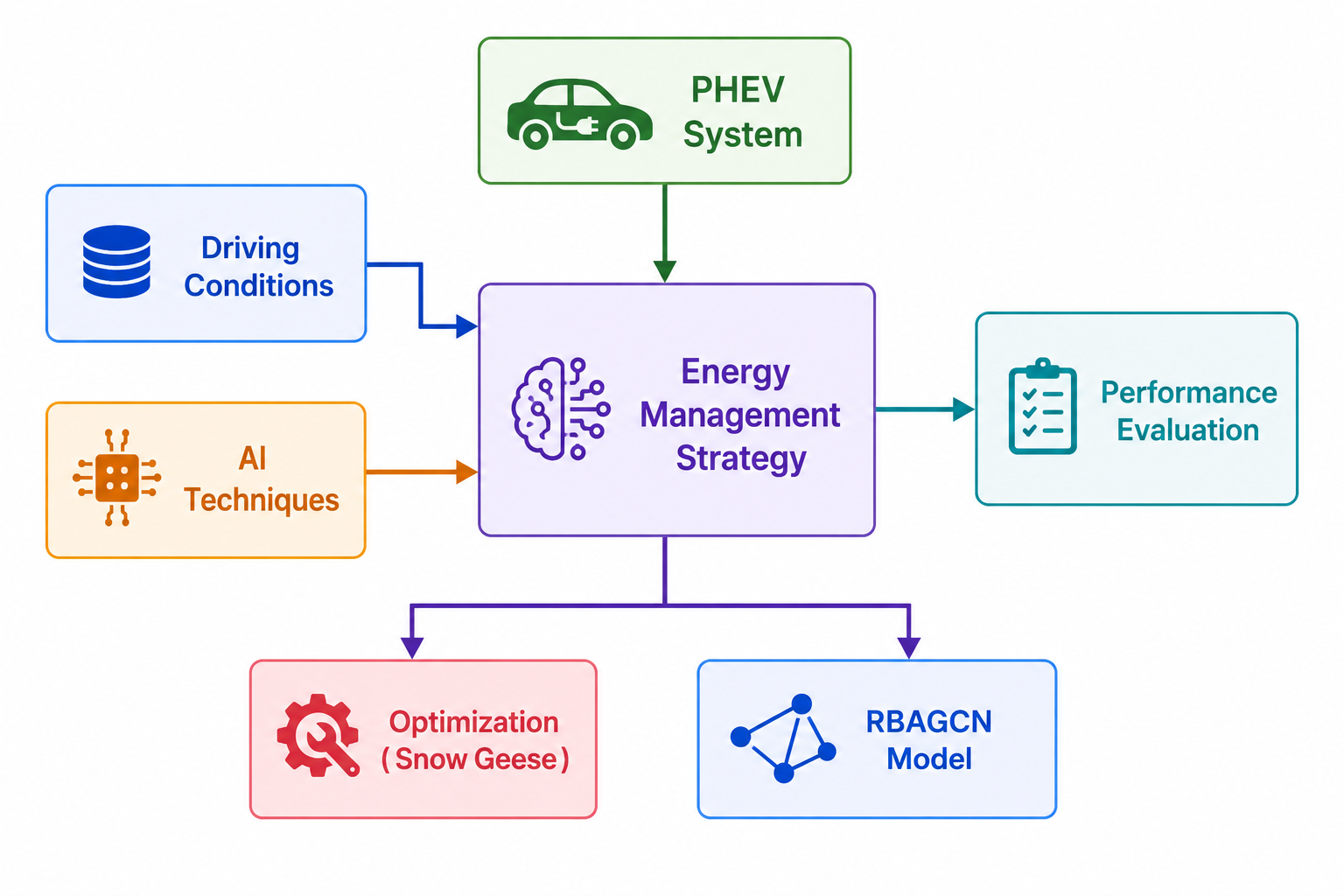
Artificial Intelligence (AI)-driven energy management strategies (EMS) have become a key enabler for improving the performance and sustainability of plug-in hybrid electric vehicles (PHEVs). Traditional EMS approaches, such as rule-based control and dynamic programming, suffer from limited adaptability and high computational complexity. Recent advancements in AI, including reinforcement learning (RL), deep learning, and graph neural networks (GNNs), provide intelligent and adaptive solutions for optimizing power distribution between the battery and internal combustion engine. Studies indicate that RL-based EMS can significantly improve fuel efficiency and real-time decision-making by learning optimal policies from dynamic driving environments. Furthermore, graph convolutional networks enable modelling of complex interdependencies among vehicle subsystems, enhancing prediction accuracy and system efficiency. Bio-inspired optimization techniques, such as Snow Geese Optimization (SGO), offer robust global search capabilities, overcoming local minima issues in traditional algorithms. The integration of SGO with Relational Bi-level Aggregation Graph Convolutional Networks (RBAGCN) provides a hybrid framework capable of capturing hierarchical relationships and optimizing multi-objective energy management problems. This paper presents a comprehensive review of AI-based EMS techniques, focusing on emerging trends, key challenges, and future directions for intelligent energy optimization in next-generation PHEVs.