Deep Learning and Optimization Approaches in LightConneuNet: Potential Analysis of Fuel Cell Vehicle-To-Grid System with Large-Scale Buildings: A Review
DOI:
https://doi.org/10.65521/ijacte.v12i1.3807Keywords:
Abstract
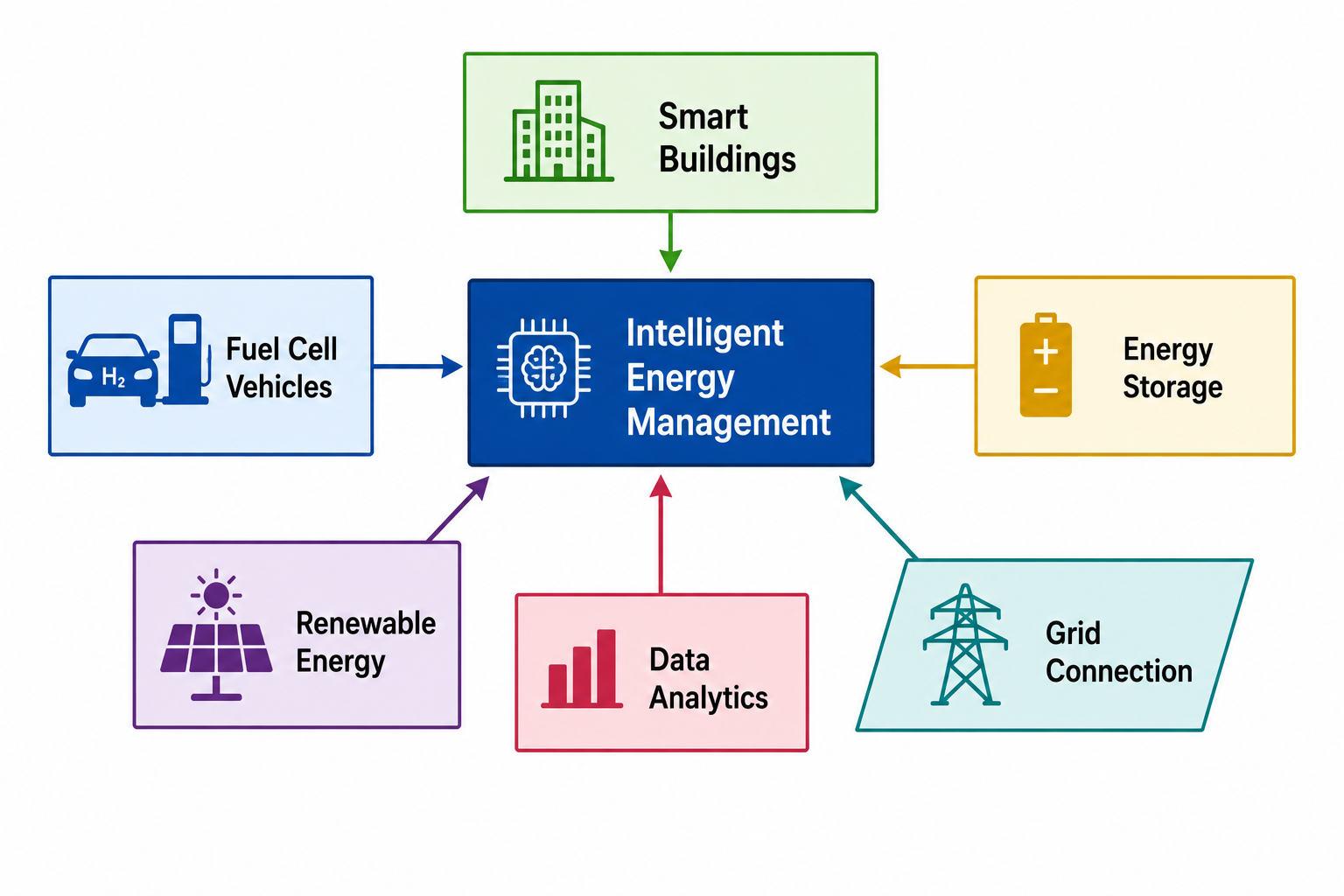
The convergence of deep learning, advanced optimization, and next-generation energy infrastructure is transforming intelligent energy management in large-scale buildings. Fuel cell vehicle-to-grid (FCV2G) systems represent a promising paradigm, enabling hydrogen-powered vehicles to act as distributed energy resources for grid support, renewable integration, and efficient energy utilization. These systems introduce complex, high-dimensional optimization challenges that require advanced computational frameworks.
This paper presents a comprehensive review of LightConneuNet, a lightweight deep learning architecture designed for efficient FCV2G optimization. By incorporating depthwise separable convolutions, attention mechanisms, and residual connections, LightConneuNet achieves high predictive accuracy with reduced computational overhead, enabling real-time deployment in building energy management systems. The review examines its integration with reinforcement learning, model predictive control, and stochastic optimization for managing bidirectional energy flows and scheduling operations under uncertainty.
Applications include peak demand reduction, energy cost optimization, renewable energy integration, and grid services such as frequency regulation and voltage support. Comparative analysis shows that LightConneuNet-based frameworks outperform traditional methods in efficiency, scalability, and adaptability. However, challenges related to hydrogen infrastructure, system integration, and regulatory constraints remain. This review highlights the potential of combining deep learning and FCV2G systems to develop scalable, intelligent, and sustainable energy management solutions.