Recent Advances in Optimal Scheduling of PV-Battery-Electric Vehicle Loads Using a Scalable Quantum Non-Local Neural Network Approach: A Systematic Review
DOI:
https://doi.org/10.65521/ijacte.v12i1.3799Keywords:
Abstract
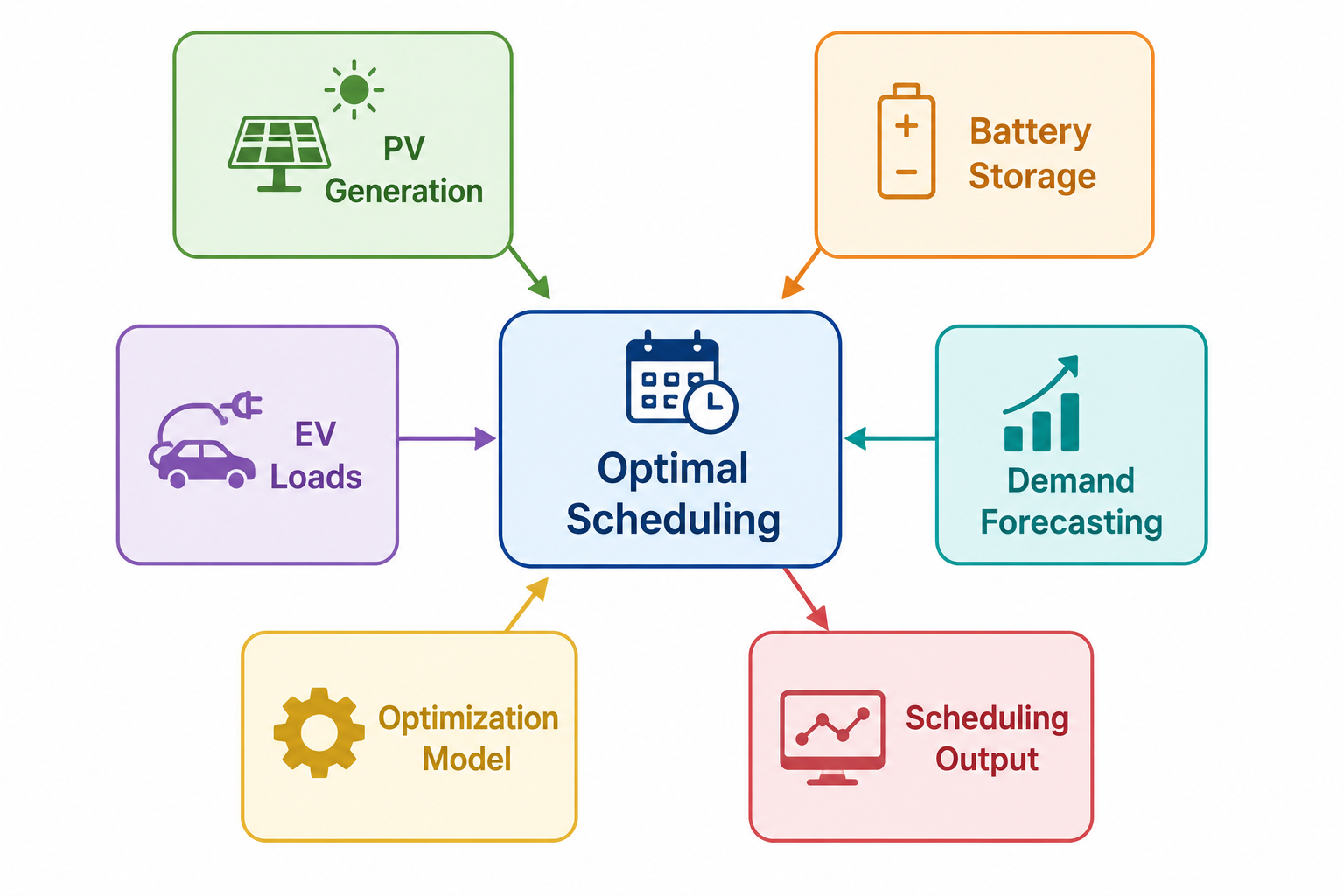
The rapid advancement of smart grids, renewable energy integration, and transportation electrification has intensified the need for efficient energy management strategies. Optimal scheduling of photovoltaic (PV) systems, battery energy storage systems (BESS), and electric vehicle (EV) loads plays a crucial role in enhancing grid stability, reducing energy costs, and improving sustainability. Traditional optimization methods often struggle with scalability, uncertainty, and non-linearity, prompting the adoption of intelligent and hybrid computational approaches. This systematic review examines recent developments in optimal scheduling frameworks using a scalable quantum non-local neural network (QNLNN) approach. Non-local neural networks effectively capture long-range dependencies and global interactions in energy systems, while quantum-inspired optimization enhances computational efficiency and solution quality for high-dimensional problems. These approaches address challenges such as renewable energy variability, dynamic pricing, and load uncertainty. The study reviews methodologies including deep reinforcement learning, metaheuristic algorithms, and hybrid models across smart grids and microgrids. It also analyzes commonly used datasets and performance metrics such as cost reduction and energy efficiency. Findings indicate that QNLNN-based models outperform traditional methods in scalability, adaptability, and optimization accuracy, offering promising solutions for intelligent, real-time energy management in next-generation smart grids.