A Survey of Methods and Architectures for E-commerce Enterprises Financial Risk Prediction Based on Hierarchical Auto-Associative Polynomial Convolutional Neural Network Model
DOI:
https://doi.org/10.65521/ijacte.v12i1.3803Keywords:
Abstract
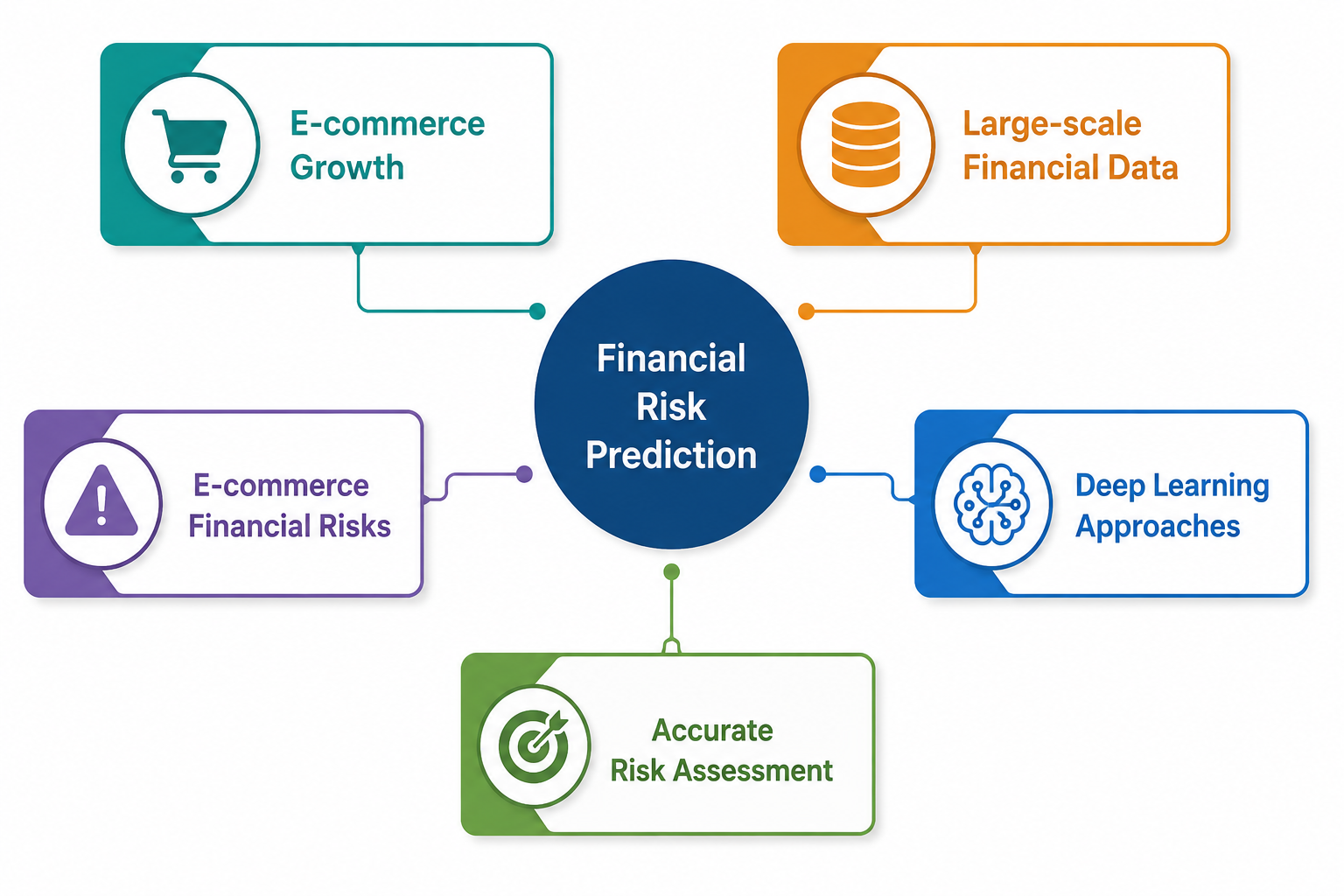
The rapid expansion of e-commerce has introduced significant challenges in financial risk prediction, requiring advanced models capable of handling high-dimensional, nonlinear, and temporally dynamic data. Traditional approaches such as logistic regression and decision tree models often fail to capture complex interdependencies within financial datasets, leading to limited predictive performance. This survey examines hierarchical auto-associative polynomial convolutional neural networks as an advanced framework for financial risk prediction in e-commerce environments. The proposed architecture integrates autoencoder-based feature learning with polynomial transformations and convolutional operations, enabling the extraction of compact and meaningful representations from heterogeneous financial data.The hierarchical structure supports multi-level feature learning, capturing both local transactional patterns and global risk indicators. Polynomial feature expansion enhances the model’s ability to represent higher-order interactions, while convolutional layers exploit spatial and temporal correlations in structured financial data. Optimization strategies such as adaptive learning rates, focal loss functions, and regularization techniques improve convergence, robustness, and performance in imbalanced datasets. Empirical evaluations across benchmark datasets demonstrate superior accuracy and generalization compared to traditional and baseline deep learning models.Despite these improvements, challenges related to interpretability, scalability, and real-world deployment remain.This review provides insights into emerging methodologies and future directions for developing intelligent and reliable financial risk prediction systems in e-commerce.