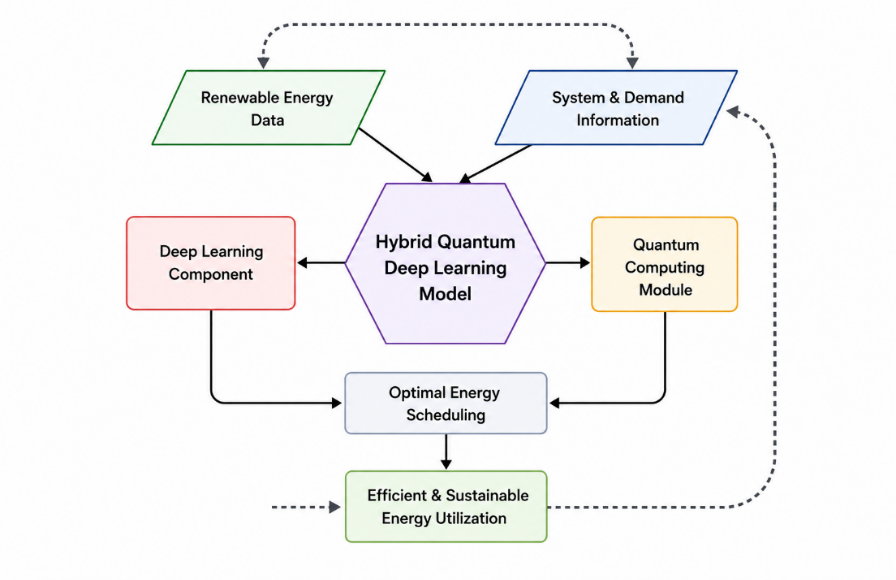
Hybrid Quantum Deep Learning for Smart Renewable Energy Scheduling
DOI:
https://doi.org/10.65521/ijacte.v15i2.3325Keywords:
Abstract
The rapid integration of renewable energy resources into modern smart grids has introduced significant challenges in energy scheduling, resource allocation, demand balancing, and operational optimization. Renewable energy sources such as solar and wind exhibit intermittent and uncertain generation patterns, making efficient scheduling a complex task. Conventional optimization techniques often struggle to handle the high-dimensional and dynamic nature of smart energy systems. Recent advances in quantum computing and deep learning have created new opportunities for developing intelligent scheduling frameworks capable of improving decision-making efficiency and computational performance. This research proposes a Hybrid Quantum Deep Learning Framework for Smart Renewable Energy Scheduling (HQDL-SRES) to optimize renewable energy utilization, reduce operational costs, improve scheduling accuracy, and enhance grid stability. The proposed framework integrates quantum-inspired optimization, deep neural learning, renewable energy forecasting, intelligent load scheduling, and adaptive resource allocation into a unified architecture. Quantum computing principles are utilized to accelerate optimization processes, while deep learning models capture complex temporal patterns within renewable energy generation and energy demand data. The framework dynamically schedules renewable energy resources accord.