Adaptive Scheduling Framework for Distributed Renewable Energy Systems
DOI:
https://doi.org/10.65521/ijacte.v15i2.3323Keywords:
Abstract
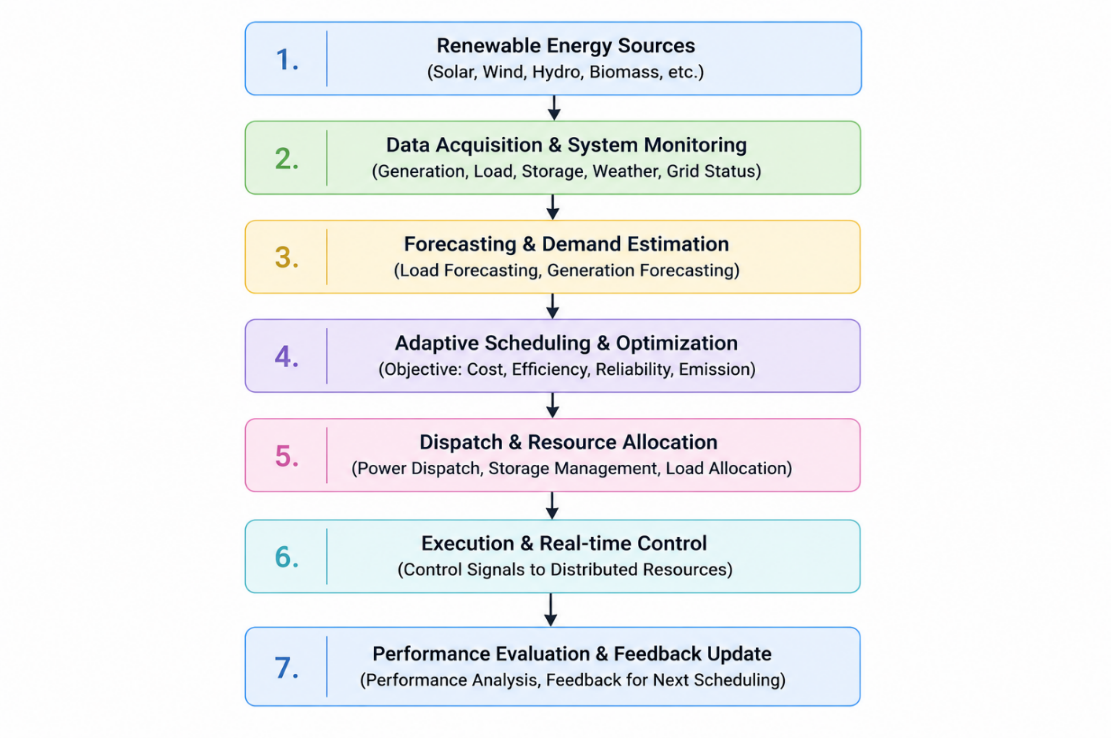
The rapid integration of distributed renewable energy resources such as solar photovoltaic systems, wind farms, battery storage units, and microgrids has transformed modern power systems into highly decentralized and dynamic energy networks. While renewable energy sources provide significant environmental and economic benefits, their intermittent and unpredictable nature introduces substantial challenges in energy scheduling, load balancing, resource allocation, and grid stability. Traditional scheduling approaches often struggle to efficiently coordinate distributed renewable resources under fluctuating generation and demand conditions. Consequently, adaptive scheduling mechanisms capable of dynamically optimizing energy distribution and resource utilization have become increasingly important for ensuring reliable and sustainable power system operation. This research proposes an Adaptive Scheduling Framework for Distributed Renewable Energy Systems (ASF-DRES) that integrates intelligent demand forecasting, adaptive resource allocation, renewable energy prediction, distributed energy management, and real-time scheduling optimization. The framework utilizes machine learning-based forecasting models and adaptive decision-making strategies to dynamically schedule energy resources according to generation availability, load demand, storage capacity, and network constraints. Multi-source renewable energy data, including solar irradiance, wind speed, battery status, and consumption patterns, are incorporated to improve scheduling efficiency and system reliability.