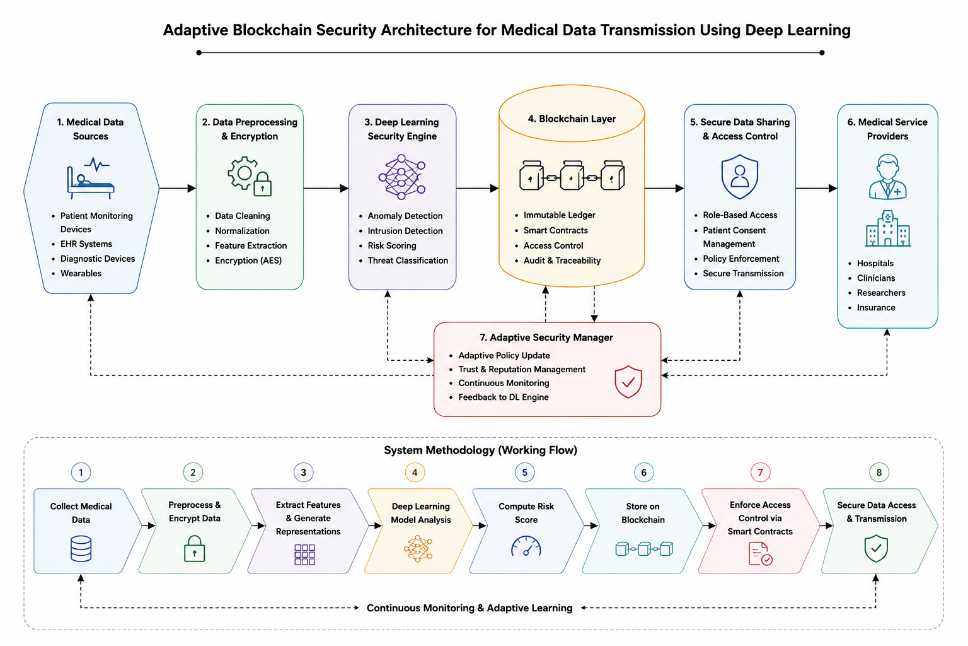
Adaptive Blockchain Security Architecture for Medical Data Transmission Using Deep Learning
DOI:
https://doi.org/10.65521/ijacte.v15i2.3320Keywords:
Abstract
The rapid digitization of healthcare systems has significantly increased the volume of medical data generated, transmitted, and stored across distributed healthcare infrastructures. Electronic Health Records (EHRs), wearable healthcare devices, telemedicine platforms, Internet of Medical Things (IoMT) systems, and cloud-based healthcare applications continuously exchange sensitive patient information that requires strong security, privacy, and integrity protection. However, conventional healthcare communication systems remain vulnerable to cyber threats such as unauthorized access, data tampering, identity spoofing, ransomware attacks, and privacy breaches. Blockchain technology has emerged as a promising solution for securing healthcare data through decentralization, immutability, transparency, and cryptographic protection. Nevertheless, traditional blockchain systems often face challenges related to scalability, adaptive threat detection, and intelligent security management. To address these limitations, this research proposes an Adaptive Blockchain Security Architecture for Medical Data Transmission Using Deep Learning (ABSA-MDTDL). The proposed framework integrates blockchain-based medical data management, deep learning-driven threat detection, adaptive security analytics, smart contract validation, and intelligent access control mechanisms.