Advanced Deep Learning Architectures for ECG-Enabled Heart Disease Prediction
DOI:
https://doi.org/10.65521/ijacte.v15i2.3300Keywords:
Abstract
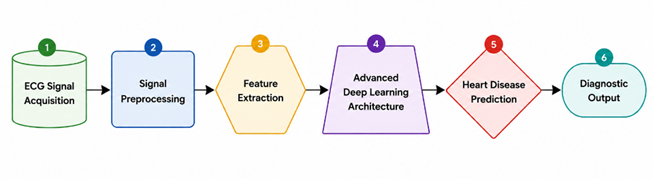
Heart disease remains a leading cause of global mortality, requiring accurate, automated, and early diagnostic systems for effective clinical intervention. Electrocardiogram (ECG) signals provide critical insights into cardiac electrical activity, making them essential for non-invasive heart disease prediction. However, ECG signals are often complex, nonlinear, and highly susceptible to noise and inter-patient variability, which limits the effectiveness of traditional diagnostic methods. This study proposes an Advanced Deep Learning Architecture for ECG-Enabled Heart Disease Prediction, integrating convolutional neural networks (CNN), recurrent neural networks (RNN/LSTM), and attention mechanisms to capture both spatial and temporal dependencies in ECG signals. The proposed model enhances feature extraction capability, improves robustness against noise, and provides high diagnostic accuracy for multi-class cardiac conditions. The system is evaluated using standard ECG datasets, and performance is measured using accuracy, precision, recall, F1-score, and ROC-AUC. Experimental results demonstrate that the proposed architecture significantly outperforms traditional machine learning models and baseline deep learning approaches. The framework is suitable for real-time clinical decision support systems and wearable healthcare monitoring devices.