Sensor-Driven Adaptive Traffic Scheduling Using MANET and Evolutionary Deep Learning Models
DOI:
https://doi.org/10.65521/ijacte.v15i2.3292Keywords:
Abstract
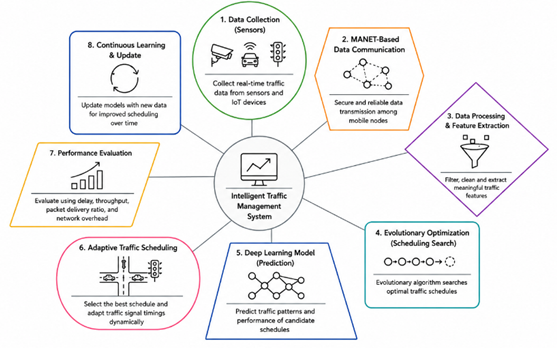
Urban traffic congestion has become a critical challenge in smart city environments due to increasing vehicle density, dynamic mobility patterns, and limited scalability of traditional traffic control systems. This research proposes a Sensor-Driven Adaptive Traffic Scheduling framework using Mobile Ad hoc Networks (MANET) integrated with Evolutionary Deep Learning Models to enable intelligent, decentralized, and real-time traffic optimization. The proposed system leverages distributed vehicular sensor data (speed, density, flow rate, and queue length) transmitted through MANET-based communication to ensure low-latency and infrastructure-independent data exchange. To enhance decision-making, an evolutionary optimization layer (Genetic Algorithm–based Deep Neural Network optimization) is used to dynamically adjust traffic signal timing and routing decisions. The deep learning model learns traffic state representations, while evolutionary strategies optimize hyperparameters and scheduling policies for adaptive performance under varying congestion scenarios. The framework supports real-time congestion prediction, dynamic signal control, and adaptive routing across interconnected intersections. Experimental evaluation (simulated urban grid environment) demonstrates improved performance compared to conventional fixed-time and adaptive systems in terms of reduced average waiting time, higher packet delivery ratio, improved throughput, and lower congestion index. The results indicate that integrating MANET with evolutionary deep learning significantly enhances scalability, robustness, and responsiveness in smart transportation systems