DeepFake Face Detection with Handcrafted Features and Logistic Regression
DOI:
https://doi.org/10.65521/ijacte.v15i2S.3001Keywords:
Abstract
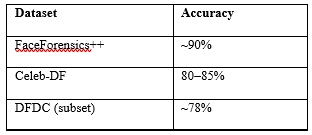
The proliferation of deepfake media, generated by sophisticated generative adversarial networks (GANs), poses significant threats to digital trust, privacy, and information integrity. This paper presents a lightweight deepfake face detection system that leverages handcrafted facial features and a binary logistic regression classifier, deliberately avoiding convolutional neural networks (CNNs) to achieve real-time performance on resource-constrained hardware. The proposed pipeline extracts Histogram of Oriented Gradients (HOG), Local Binary Patterns (LBP), and geometric facial landmark metrics (e.g., Eye Aspect Ratio) from video frames using OpenCV and DLib, concatenating them into a unified feature vector fed into a gradient-descent-trained logistic regression model. The system is deployed via a Flask web interface enabling browser-based inference. Evaluation on standard benchmarks demonstrates approximately 90% accuracy on FaceForensics++ and 80–85% on Celeb-DF, with inference running at over 30 FPS on a standard CPU. The approach substantially outperforms CNN-based methods in training speed and inference efficiency while achieving competitive detection accuracy on moderate-quality deepfakes. Limitations due to absent temporal modeling and sensitivity to compression artifacts are discussed along with directions for future enhancement.