A Survey of Methods and Architectures for Prediction of Routing Scenarios in IoT-based MANETs using ERS, RED, and Global Pooling Dilated CNN
DOI:
https://doi.org/10.65521/ijacte.v14i2.2770Keywords:
Abstract
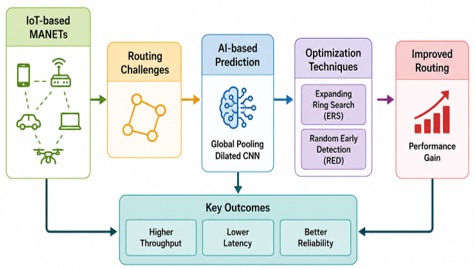
The rapid growth of Internet of Things (IoT) applications has increased the demand for intelligent and adaptive routing mechanisms in Mobile Ad Hoc Networks (MANETs), which operate in dynamic and resource-constrained environments. Traditional routing protocols often fail to handle frequent topology changes, congestion, and limited energy resources, resulting in reduced network efficiency and Quality of Service (QoS). This survey reviews recent methods and architectures for routing prediction in IoT-based MANETs, with particular emphasis on Artificial Intelligence (AI)-driven optimization techniques such as Expanding Ring Search (ERS) and Random Early Detection (RED). The study highlights the role of machine learning, deep learning, and reinforcement learning models in enabling adaptive and intelligent routing decisions. Special focus is given to global pooling dilated Convolutional Neural Networks (CNNs), which effectively capture spatial and temporal network dependencies for accurate prediction of congestion, link stability, and routing paths. The integration of AI with ERS and RED significantly reduces routing overhead and improves congestion control. Emerging trends including graph neural networks, edge intelligence, and security-aware routing are also discussed. Despite notable performance improvements, challenges related to scalability, computational complexity, and real-time implementation remain, motivating future research into lightweight and federated AI-based routing frameworks for next-generation IoT networks.