A Comprehensive Review of Strategy Design for Energy-Efficient Data Offloading in 6G-Enabled Vehicular Edge Computing Networks Using Double Deep Q-Network
DOI:
https://doi.org/10.65521/ijacte.v14i1.2762Keywords:
Abstract
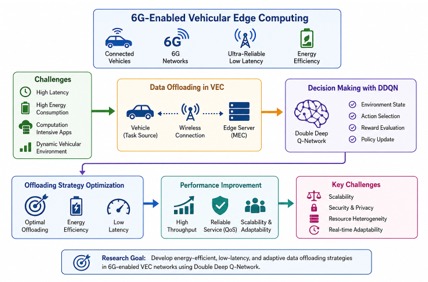
The rapid evolution of intelligent transportation systems and the emergence of sixth-generation (6G) networks have significantly increased the demand for real-time, energy-efficient computation in vehicular environments. Vehicular Edge Computing (VEC) has emerged as a promising paradigm to reduce latency and enhance system efficiency by offloading computation tasks from vehicles to edge servers. However, dynamic vehicular mobility, fluctuating network conditions, and resource constraints pose critical challenges in achieving optimal energy-efficient data offloading. Recently, Deep Reinforcement Learning (DRL), particularly Double Deep Q-Network (DDQN), has shown remarkable potential in addressing these challenges through adaptive and intelligent decision-making. This paper presents a comprehensive review of strategy design for energy-efficient data offloading in 6G-enabled VEC networks, focusing on DDQN-based approaches. The study analyses recent advancements, highlighting optimization techniques, system architectures, and performance trade-offs. It further explores hybrid models integrating DRL with edge computing, resource allocation, and communication technologies. Comparative insights reveal that DDQN-based strategies outperform traditional optimization and heuristic methods in terms of energy consumption, latency reduction, and adaptability. Finally, the paper identifies key research gaps and future directions for designing scalable, secure, and energy-aware offloading frameworks in next-generation vehicular networks.