Preparation and Characterization of Biodegradable Polymer Composites for Sustainable Packaging Applications
DOI:
https://doi.org/10.65521/ijacsa.v7i1.4372Keywords:
Abstract
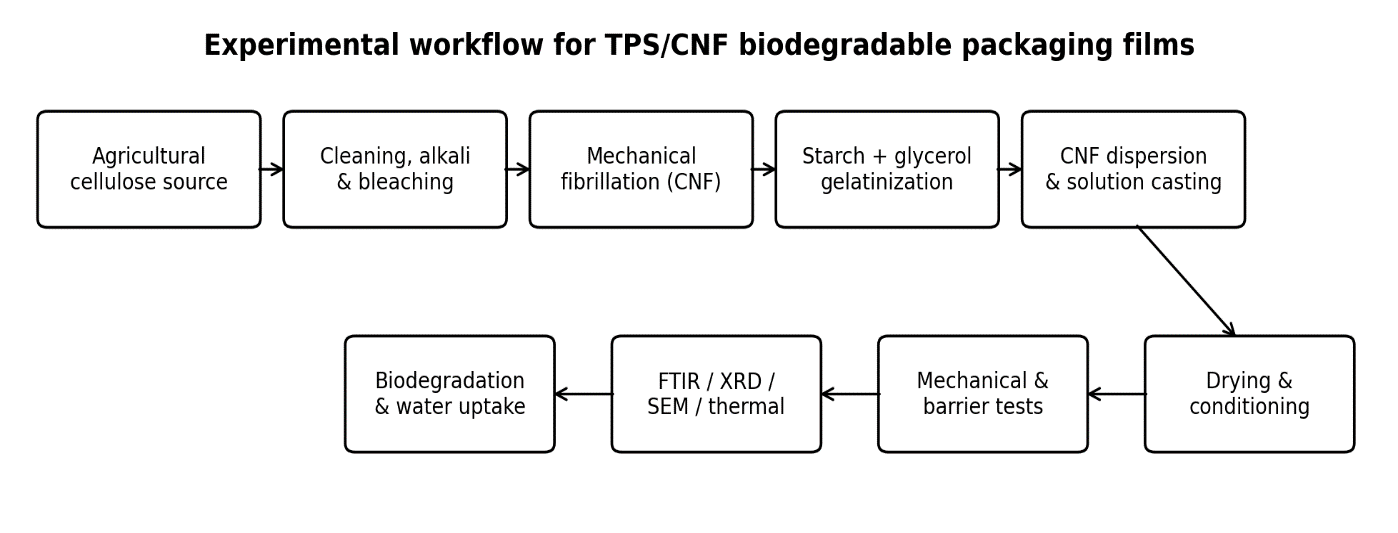
The growing accumulation of persistent petroleum-derived packaging waste has increased interest in biodegradable polymer composites prepared from renewable feedstocks. This methodology paper presents a laboratory-scale route for preparing thermoplastic starch/cellulose nanofiber (TPS/CNF) composite films intended for sustainable packaging. Corn starch is plasticized with glycerol, while cellulose nanofibers obtained from lignocellulosic agricultural residue are used as reinforcing filler. Films containing 0-5 wt% CNF are produced by aqueous gelatinization, controlled dispersion, solution casting, drying and conditioning. The characterization plan combines Fourier-transform infrared spectroscopy, X-ray diffraction, scanning electron microscopy, thermal analysis, tensile testing, water-vapor transmission, water uptake, optical transparency and soil-burial biodegradation. The experimental design is intended to identify the filler loading that improves stiffness and barrier performance without excessive embrittlement or nanofiber agglomeration. Literature published up to 2018 indicates that cellulose reinforcement can significantly improve the strength, modulus, crystallinity and moisture-barrier properties of starch and other biodegradable polymer matrices. The proposed approach therefore provides a reproducible framework for evaluating bio-based composite films as lower-impact alternatives for short-life packaging applications