Experimental Investigation of Biodiesel Production Using Heterogeneous Catalysts from Waste-Derived Materials
DOI:
https://doi.org/10.65521/ijacsa.v7i1.4369Keywords:
Abstract
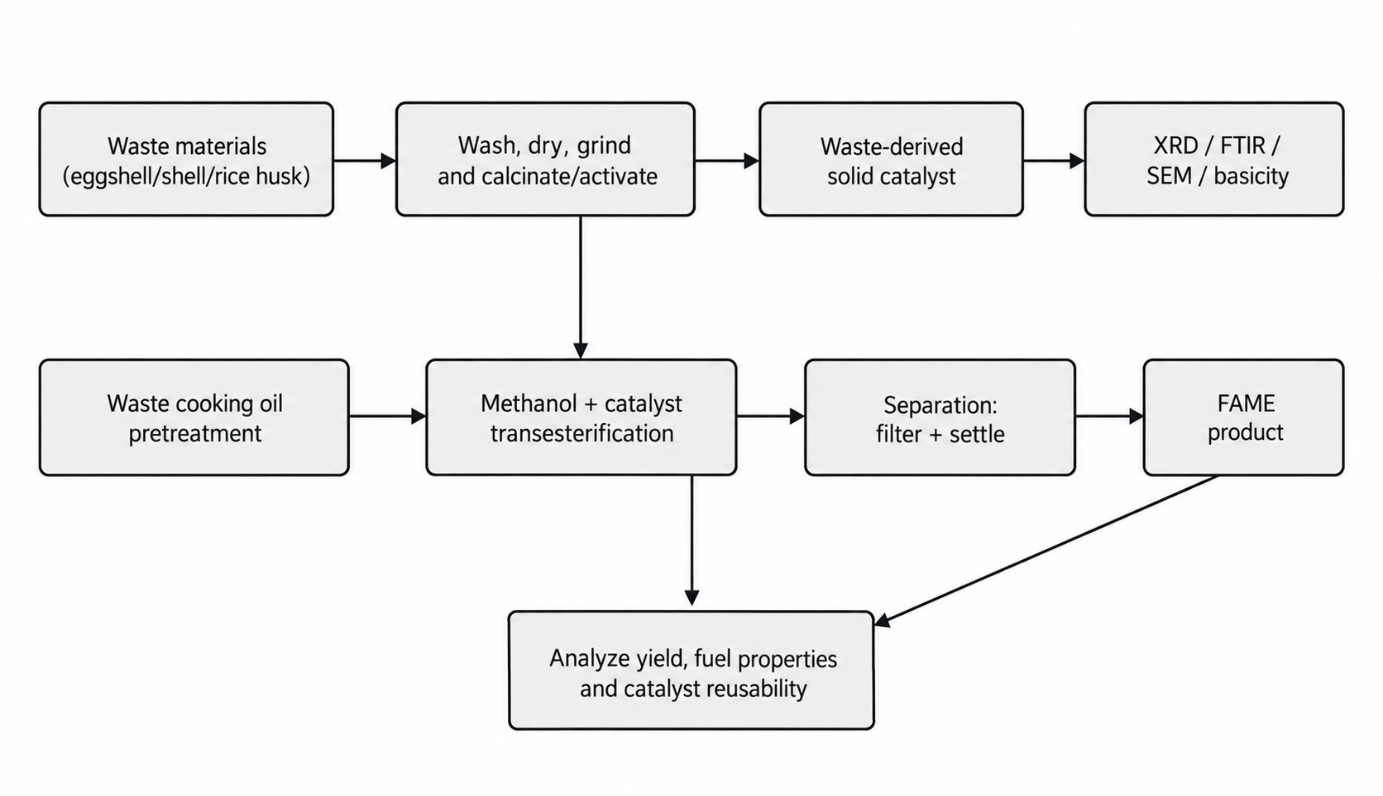
The increasing cost of conventional biodiesel catalysts and the environmental burden associated with solid wastes have motivated the development of low-cost heterogeneous catalysts derived from discarded biological and agricultural materials. This methodology paper proposes an experimental investigation of biodiesel production from waste cooking oil using three representative waste-derived catalysts: calcium oxide obtained from calcined eggshell or mollusk shell, and sodium silicate produced from rice-husk ash. The study integrates feedstock pretreatment, catalyst preparation, physicochemical characterization, batch transesterification, product separation, fuel-quality assessment, and catalyst reusability. The principal variables are methanol-to-oil molar ratio, catalyst loading, reaction temperature, and reaction time. Catalyst phase development is evaluated by X-ray diffraction and Fourier-transform infrared spectroscopy, while surface morphology and basicity are assessed by scanning electron microscopy and indicator/basicity methods. Biodiesel conversion is quantified as fatty acid methyl ester (FAME) yield and supported by density, viscosity, acid value, and flash-point measurements. Literature published up to 2018 shows that shell-derived CaO and rice-husk-derived sodium silicate can attain high ester yields under optimized conditions [2-10]. The proposed methodology therefore provides a reproducible framework for comparing catalytic activity, energy requirement, ease of separation, and reuse performance while simultaneously valorizing waste materials and waste oil. The approach is suitable for laboratory-scale experimental validation and can be extended to process optimization using response-surface or factorial designs.