Performance Optimization of Software-Defined Networks for Next-Generation Communication Systems
DOI:
https://doi.org/10.65521/ijacsa.v8i1.4165Keywords:
Abstract
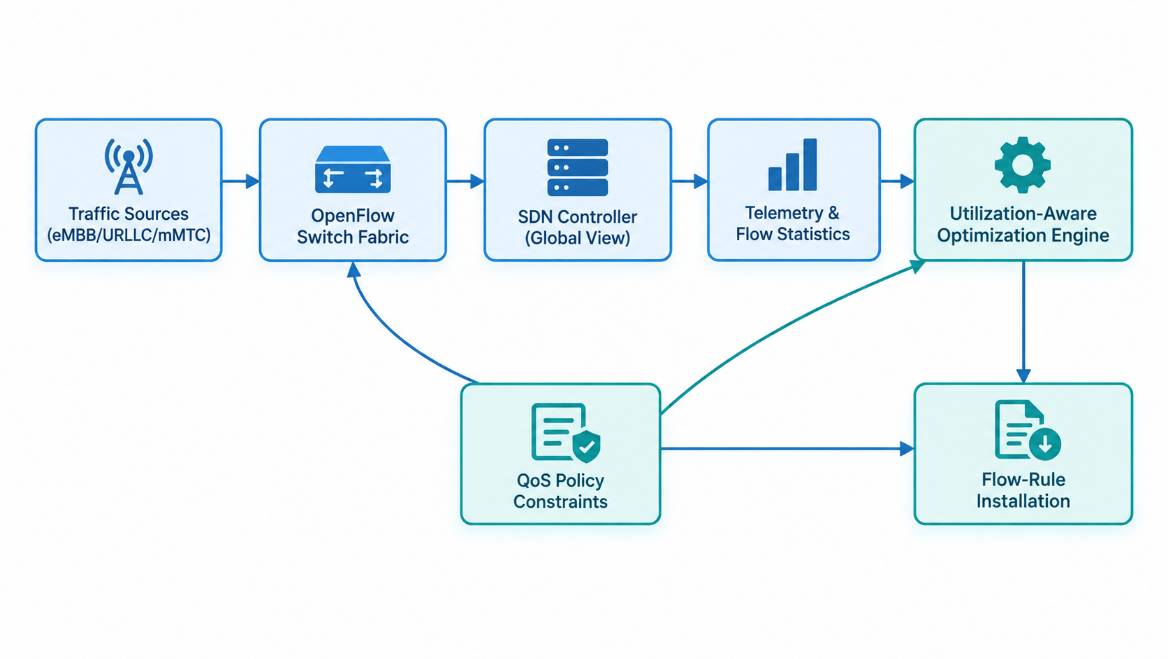
Software-Defined Networking (SDN) provides a programmable control plane that can dynamically adapt forwarding behavior to changing traffic conditions. This capability is particularly important for next-generation communication systems, where enhanced mobile broadband, ultra-reliable low-latency communication, massive machine-type communication, edge services, and virtualized network functions create highly variable bandwidth and delay requirements. This methodology paper develops a reproducible performance-optimization framework for SDN based on continuous telemetry, utilization-aware path selection, QoS constraints, and closed-loop flow-rule installation. The proposed method separates monitoring from decision making: OpenFlow counters are sampled periodically, link utilization is estimated, candidate paths are ranked using a composite cost, and new or congested flows are redirected before persistent overload occurs. A controlled numerical evaluation, designed to mirror a Mininet/Open vSwitch experimental workflow, compares conventional shortest-path forwarding with the proposed adaptive scheme for 10-, 20-, and 40-switch networks. Under the heaviest tested load, the optimization model increased delivered throughput from 92.92% to 99.73%, reduced mean end-to-end delay from 19.03 ms to 8.88 ms, and reduced estimated packet loss from 7.08% to 0.27%. The results indicate that closed-loop, utilization-aware traffic engineering can substantially improve scalability and QoS while retaining the programmability advantages of SDN. All literature used in this manuscript is from 2019 or earlier, and DOI identifiers are provided in the reference list.