
Trustworthy Federated Clinical Intelligence with Homomorphic Encryption and Explainable AI
DOI:
https://doi.org/10.65521/ijacect.v15i2.4793Keywords:
Abstract
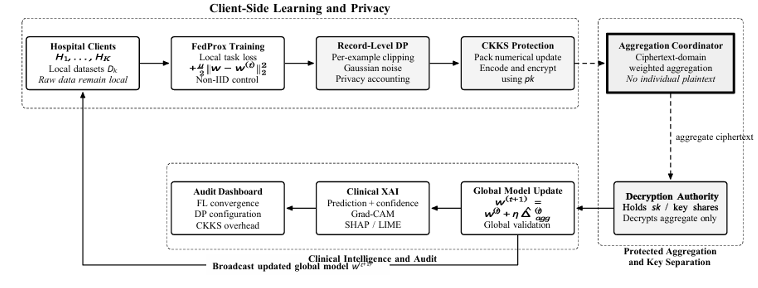
Cross-institutional clinical artificial intelligence is constrained by fragmented patient data, non-identically distributed (non-IID) populations, leakage from shared model updates, and limited interpretability. Federated learning (FL) preserves data locality, but ordinary FL neither makes model updates confidential nor guarantees stable optimization under heterogeneous clients. This paper proposes a defense-in-depth framework that coordinates Federated Proximal (FedProx) optimization, record-level differential privacy (DP), Cheon–Kim–Kim–Song (CKKS) approximate homomorphic encryption, and explainable artificial intelligence (XAI). FedProx limits local model drift; DP-SGD bounds the influence of an individual training record; and CKKS permits weighted aggregation while client updates remain encrypted. A key-separated design keeps the aggregation server from being provisioned with the secret key used to reveal individual contributions; only the aggregate is released for global-model construction. Grad-CAM and SHAP/LIME provide clinician-facing explanations, while an audit dashboard reports convergence, privacy-accounting inputs, encryption status, and systems overhead. We formalize the learning objective, privacy mechanism, encrypted aggregation, threat model, numerical approximation error, communication footprint, and an evaluation protocol spanning IID and controlled non-IID partitions. The contribution is a reproducible system-level co-design and evaluation framework rather than a new cryptographic primitive or optimization algorithm.
Downloads
Published
How to Cite
Issue
Section
License

This work is licensed under a Creative Commons Attribution-NoDerivatives 4.0 International License.