
An Overview of Mental Health Prediction Using Machine Learning: Recent Progress and Challenges
DOI:
https://doi.org/10.65521/ijacect.v14i3s.4721Keywords:
Abstract
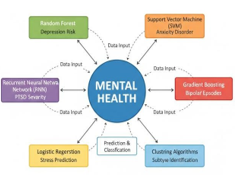
Mental health disorders are a growing global concern, affecting hundreds of millions of individuals and imposing substantial social, economic, and personal burdens. Early and accurate prediction of mental health states—such as depression, anxiety, stress, suicidal ideation, and mood disorders—can enable timely intervention and improved outcomes. In recent years, machine learning (ML), including deep learning and hybrid approaches, has shown promise in detecting and predicting mental health conditions from a wide variety of data modalities: text, social media, audio, video, physiological signals, and multimodal combinations. This survey reviews the literature from 2018–2025, categorizing works by data type, algorithmic approach, evaluation methodology, and mental health target. We also analyse publicly available datasets, performance metrics, and the challenges related to data imbalance, bias, interpretability, privacy, and clinical deployment. We identify emerging trends such as multimodal fusion, foundation models, federated learning, and explainable AI, which hold promise to overcome existing gaps. Finally, we propose future research directions aimed at strengthening generalization, fairness, ethical compliance, and integration into real-world healthcare settings. This paper is intended to guide researchers, clinicians, and policymakers toward developing reliable, trustworthy, and effective ML systems for mental health prediction.
Downloads
Published
How to Cite
Issue
Section
License

This work is licensed under a Creative Commons Attribution-NoDerivatives 4.0 International License.
