Machine Learning-Based Intrusion Detection System for Secure Wireless Networks
Keywords:
Abstract
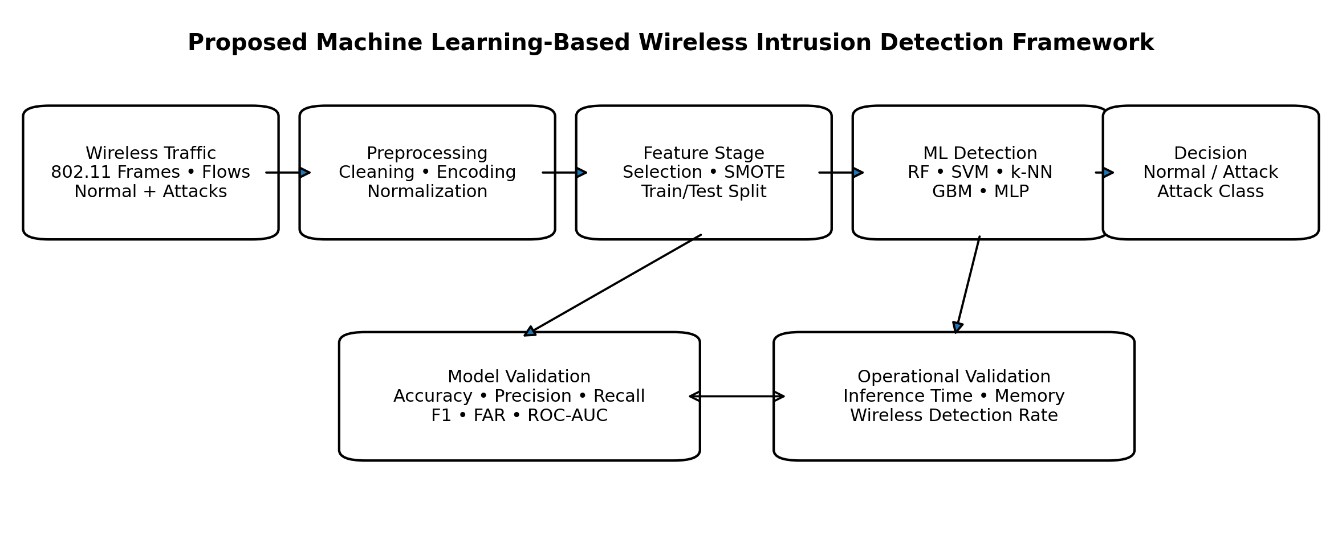
Wireless networks are exposed to denial-of-service, flooding, injection, impersonation, spoofing and unauthorized-access attacks because communication is broadcast through a shared medium and frequently involves mobile or resource-constrained devices. Conventional signature-based intrusion detection is effective for known attack patterns but is less capable of recognizing new or modified attacks. Machine learning (ML) offers a data-driven alternative in which normal and malicious wireless traffic are learned from packet or flow features and classified automatically. This methodology paper proposes a reproducible ML-based intrusion detection system (IDS) for secure wireless networks using the Aegean Wi-Fi Intrusion Dataset (AWID) as the primary wireless benchmark and UNSW-NB15/CICIDS2017 as supplementary datasets for robustness checks. Earlier studies establish the suitability of ML and deep learning for network intrusion detection (Buczak & Guven, 2016; Yin et al., 2017; Shone et al., 2018; Vinayakumar et al., 2019), while wireless-specific research demonstrates the importance of carefully selected features and multi-stage classification in IEEE 802.11 environments (Sethuraman et al., 2019; Reyes et al., 2020). The proposed methodology compares Random Forest, Support Vector Machine, k-Nearest Neighbours, Gradient Boosting and a multilayer perceptron. Preprocessing includes missing-value treatment, categorical encoding, normalization, class-imbalance handling and feature selection. Models are evaluated with accuracy, precision, recall, F1-score, false-alarm rate, ROC-AUC and inference time using stratified train-validation-test partitions and repeated cross-validation. Because no experimental dataset files were supplied in this request, the Results section uses clearly labelled illustrative values and expected patterns rather than fabricated empirical outcomes. The framework provides a step-by-step basis for selecting an accurate, low-false-alarm and computationally efficient IDS for wireless network deployment.