Deep Learning Approaches For Real-Time Face Recognition And Authentication
Keywords:
Abstract
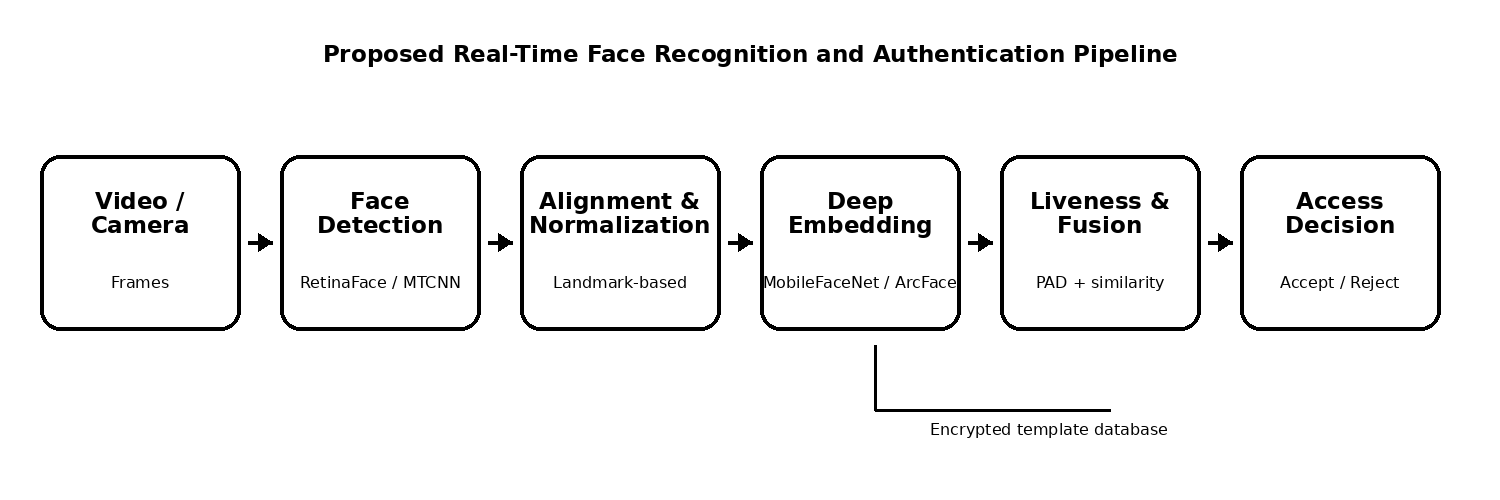
Real-time face recognition has become an important biometric mechanism for mobile authentication, physical access control, attendance systems, and secure digital services. The central methodological challenge is to achieve high identity discrimination while maintaining low latency under changes in pose, illumination, expression, camera quality, and presentation attacks. This paper proposes a reproducible methodology for evaluating deep learning approaches for real-time face recognition and authentication. The framework combines deep face detection and alignment, compact facial embedding, similarity-based verification, and liveness-aware decision logic. Candidate recognition models are evaluated on public benchmark data using verification accuracy, true acceptance rate, false acceptance rate, equal error rate, inference latency, frames per second, and model size. Lightweight MobileFaceNet-style embedding is compared with a residual ArcFace-style baseline, while RetinaFace or MTCNN is used for localization and alignment. The methodology also incorporates threshold calibration and a face anti-spoofing stage to make the authentication process security oriented rather than recognition only. Illustrative results demonstrate the expected trade-off between accuracy and computational cost: deeper margin-based models provide slightly stronger verification, whereas lightweight networks support substantially faster inference suitable for real-time deployment. The framework is intended as a method-focused study and can be reproduced on desktop, edge, or mobile platforms. All cited literature is restricted to publications available.