Design and Analysis of Energy-Efficient Routing Protocols for Wireless Sensor Networks
Keywords:
Abstract
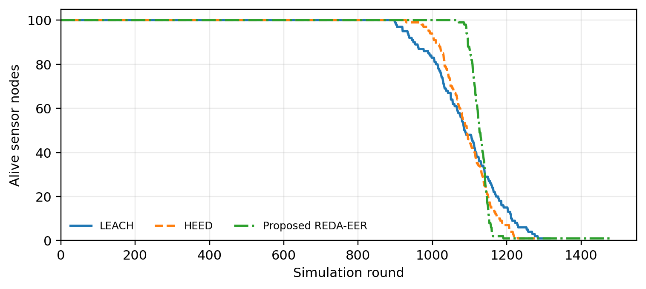
Wireless sensor networks (WSNs) are constrained by finite battery capacity, and radio communication typically dominates node energy expenditure. This paper presents a methodology for designing and evaluating an energy-efficient hierarchical routing protocol for static WSN deployments. The proposed Residual-Energy, Distance and Area-aware Energy-Efficient Routing (REDA-EER) method combines three cluster-head selection factors: residual node energy, local node centrality, and distance to the base station. A spatial-diversity term is added during cluster-head election so that selected heads are not concentrated in one part of the sensing field. The method is evaluated through a reproducible first-order radio-model simulation with 100 homogeneous nodes in a 100 m x 100 m area and is compared with LEACH and a HEED-like residual-energy baseline. The simulation indicates that REDA-EER delays first-node death, maintains at least half of the nodes alive for longer, and extends last-node lifetime in the selected scenario. The study demonstrates how multi-factor cluster-head selection can reduce avoidable transmission distances and distribute forwarding load more evenly while retaining low-complexity distributed operation.