Cloud Computing Resource Allocation Using Hybrid Optimization Techniques
Keywords:
Abstract
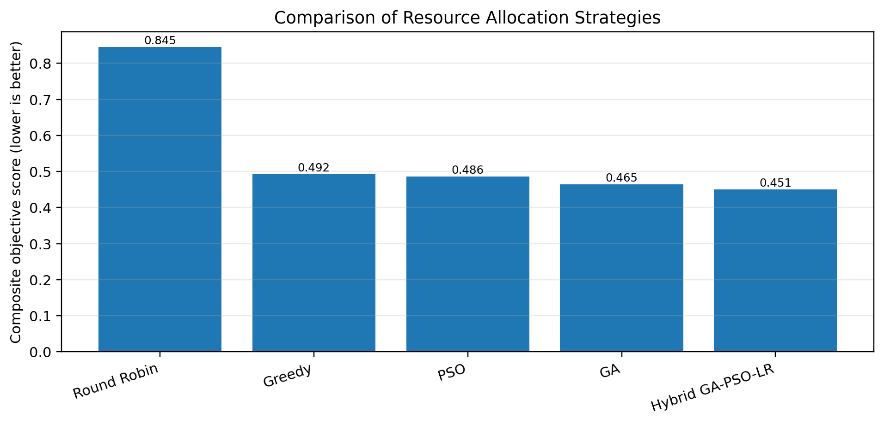
Efficient cloud resource allocation requires mapping heterogeneous user tasks to virtual machines (VMs) while simultaneously controlling execution time, service cost, load imbalance, and resource under-utilization. Single metaheuristics can provide useful schedules, but they may converge prematurely or spend excessive iterations exploring weak regions of the search space. This methodology paper proposes a Hybrid Genetic Algorithm-Particle Swarm Optimization with Load-aware Repair (HGA-PSO-LR) model for task-to-VM allocation. Genetic search supplies population diversity and global exploration, particle-swarm refinement exploits promising regions, and a final repair phase relocates selected tasks from overloaded VMs when the multi-objective fitness improves. A reproducible proof-of-concept simulation with 80 heterogeneous tasks and eight VMs is used to demonstrate the evaluation procedure. The proposed model is compared with Round Robin, a greedy earliest-completion heuristic, standalone PSO, and standalone GA. The hybrid method obtains the lowest composite objective score (0.451), reduces makespan from 246.54 s under Round Robin to 137.86 s, and increases average VM utilization from 63.54% to 98.64%. These values are specific to the stated fixed-seed simulation and are presented to demonstrate the methodology rather than as universal cloud-performance claims