Performance Evaluation of IoT-Enabled Smart Healthcare Monitoring Systems
Keywords:
Abstract
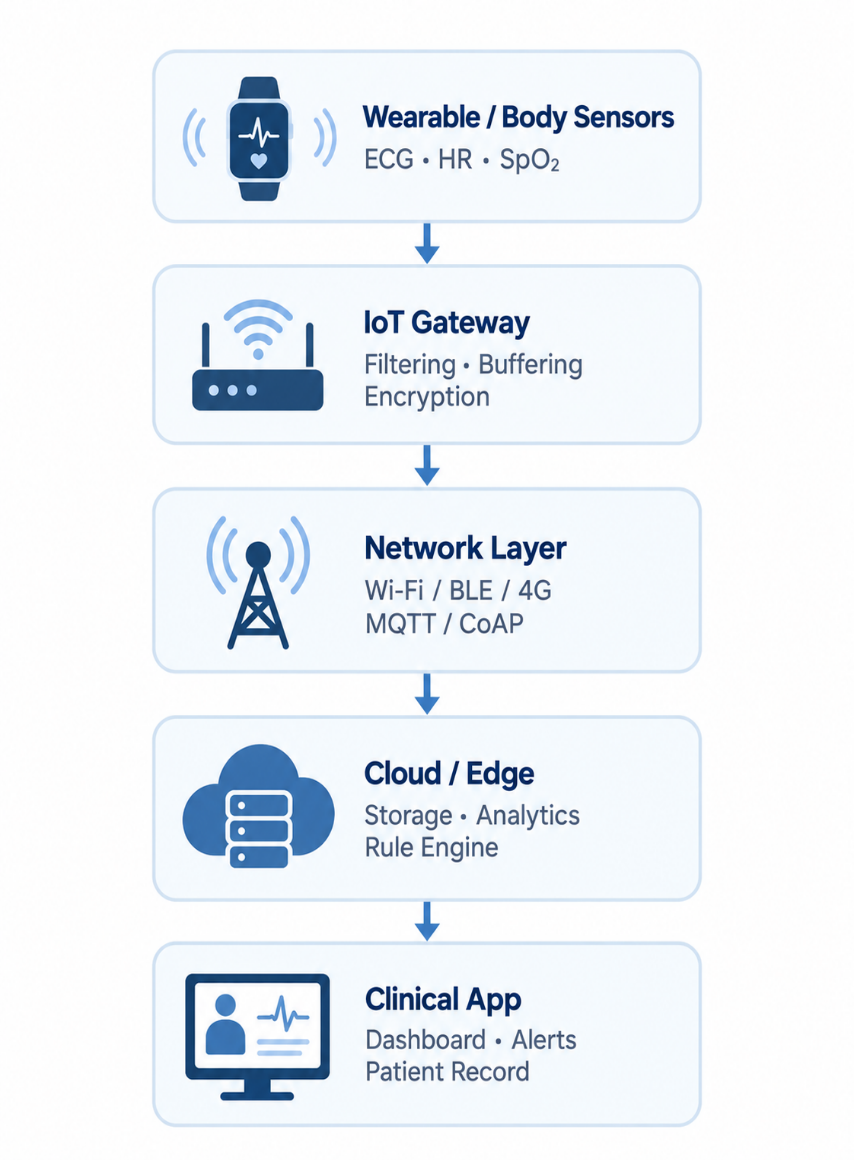
Internet of Things (IoT)-enabled healthcare monitoring integrates wearable or body sensors, wireless communication, gateways, cloud/edge computing, analytics, and clinical interfaces to provide continuous observation of physiological conditions. Although such systems promise timely intervention and remote care, their usefulness depends on measurable performance characteristics such as sensing accuracy, communication reliability, end-to-end delay, availability, energy consumption, scalability, and alert responsiveness. This methodology paper proposes a structured framework for evaluating an IoT-enabled smart healthcare monitoring system under reproducible operating conditions. The proposed testbed models wearable sensors that acquire heart rate, body temperature, blood oxygen saturation (SpO2), and electrocardiogram-related observations; an IoT gateway that filter and encrypts data; wireless transmission to an edge/cloud layer; and a monitoring application that stores data and issues threshold-based alerts. The evaluation combines device-level, network-level, application-level, and security-oriented metrics. Comparative experiments vary device density, packet generation interval, communication load, and abnormal-event frequency. Illustrative results demonstrate how a well-configured architecture can maintain high packet-delivery ratio and system availability while preserving low alert latency under moderate load. The approach is intended as a replicable methodology for researchers assessing smart healthcare platforms rather than as a report of clinical field measurements.