Comparative Analysis of Cloud Resource Allocation Techniques Using Metaheuristic Algorithms
Keywords:
Abstract
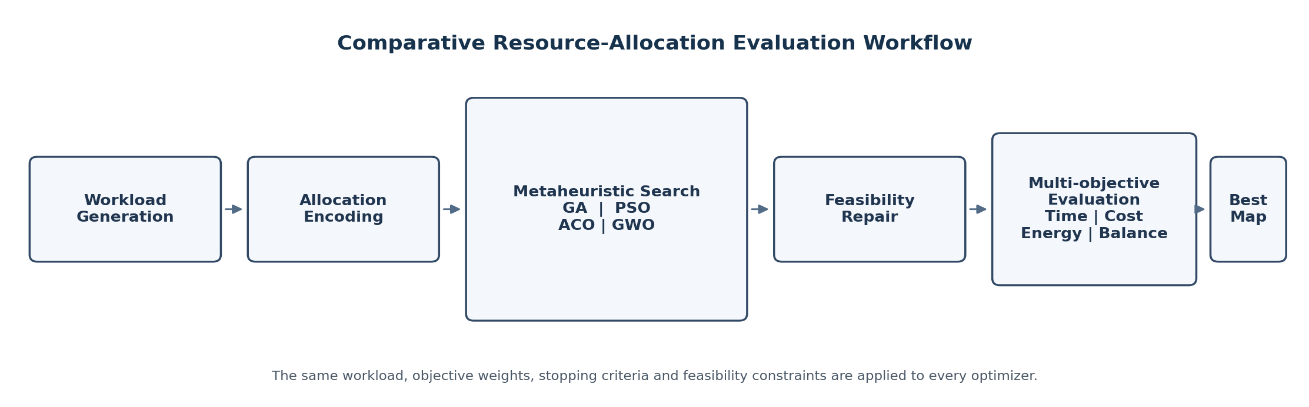
Cloud resource allocation requires mapping dynamically arriving computational tasks to heterogeneous virtual machines (VMs) while simultaneously controlling completion time, monetary cost, energy use, and resource imbalance. Because the search space grows exponentially with the number of tasks and resources, exact optimization rapidly becomes impractical for realistic cloud workloads. This methodology paper develops a controlled comparative framework for four representative metaheuristic algorithms—Genetic Algorithm (GA), Particle Swarm Optimization (PSO), Ant Colony Optimization (ACO), and Grey Wolf Optimization (GWO). A reproducible heterogeneous cloud model containing 100 independent tasks and 10 VMs is evaluated under a common multi-objective fitness function. The study uses repeated stochastic trials, identical stopping conditions, and the same workload for all algorithms. Experimental results show that GA achieved the lowest aggregate objective score (0.620), followed by PSO (0.631), ACO (0.689), and GWO (0.700). GA reduced makespan by approximately 60.7% and the utilization-imbalance index by about 90.0% relative to a round-robin baseline, while ACO produced the lowest mean energy consumption among the compared metaheuristics. The findings indicate that no single optimizer dominates every metric; however, population-based evolutionary search offers a strong balance between convergence quality and allocation stability. The proposed methodology can be extended to deadline-aware workflows, VM migration, and multi-cloud scheduling.