Real-Time Facial Recognition System Using Convolutional Neural Networks
Keywords:
Abstract
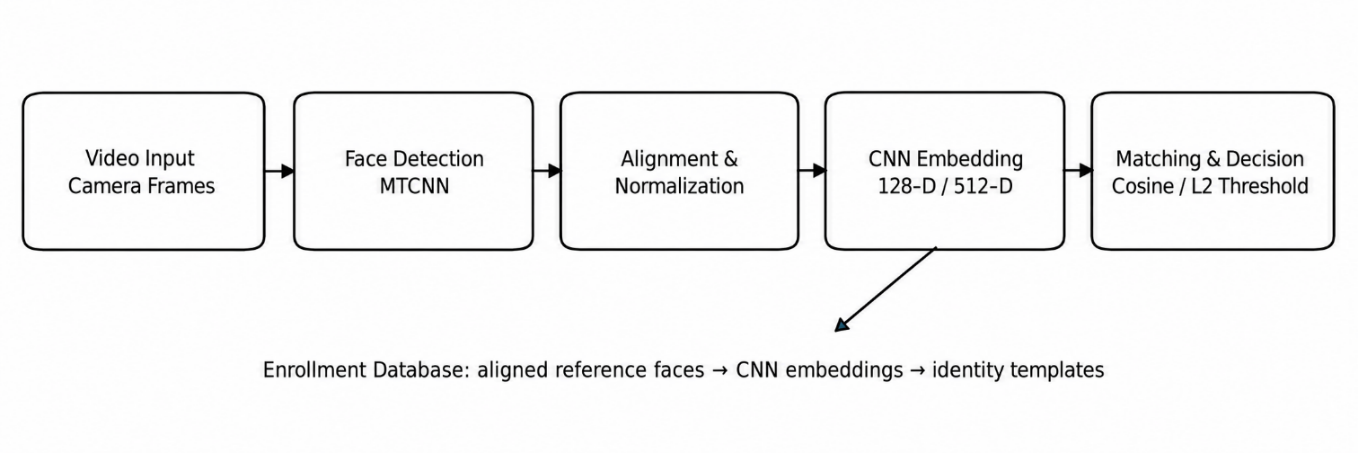
Real-time facial recognition combines image acquisition, face detection and alignment, convolutional neural network (CNN) feature extraction, similarity matching, and identity decision within a strict latency budget. This methodology paper proposes a reproducible design for developing and evaluating a real-time facial recognition system using CNNs, with references limited to 2019 and earlier. Deep learning transformed face recognition by learning identity-discriminative representations directly from large image datasets. DeepFace demonstrated near-human verification performance using deep neural representations, Deep ID showed that identity classification can produce compact face features, and FaceNet introduced metric-learning embeddings in which distance directly represents facial similarity. VGGFace further demonstrated the importance of large-scale data and end-to-end CNN training. For real-time deployment, robust detection and alignment are provided by cascaded CNN detectors such as MTCNN, while efficient architectures such as MobileFaceNets reduce computation on mobile or embedded hardware. Margin-based objectives including center loss, SphereFace, CosFace, and ArcFace progressively improve intra-class compactness and inter-class separation. The proposed methodology uses a camera stream, MTCNN-based detection, aligned face crops, a CNN embedding network, and cosine-distance matching against an enrollment database. Accuracy, precision, recall, F1-score, false-accept rate, false-reject rate, ROC-AUC, frame rate, per-frame latency, model size, and memory use are evaluated under lighting, pose, distance, occlusion, and multi-face conditions. Because no experimental dataset or camera logs were supplied, the Results section reports illustrative expected patterns rather than fabricated measurements.