Energy-Efficient Routing Protocols for Wireless Sensor Networks: A Comparative Study
Keywords:
Abstract
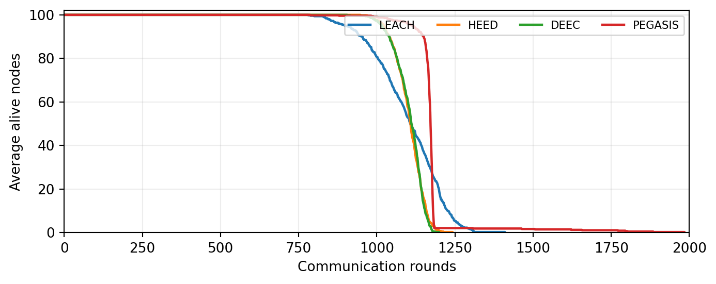
Wireless sensor networks (WSNs) are constrained primarily by the finite battery capacity of sensor nodes, making routing strategy a decisive factor in network lifetime. This methodology paper presents a comparative framework for four influential energy-efficient routing protocols: Low-Energy Adaptive Clustering Hierarchy (LEACH), Power-Efficient Gathering in Sensor Information Systems (PEGASIS), Hybrid Energy-Efficient Distributed clustering (HEED), and Distributed Energy-Efficient Clustering (DEEC). The study combines literature-based protocol analysis with a controlled first-order radio-energy simulation. A common 100-node, 100 m x 100 m deployment, 0.5 J initial node energy, 4000-bit packets, and identical radio-energy coefficients are applied to all protocols. Performance is evaluated using first-node death, half-node death, last-node death, routing overhead, scalability, and load-balancing behavior. The simulation indicates that PEGASIS provides the longest tail lifetime, while HEED and DEEC delay the first node failure through energy-aware cluster-head selection. LEACH remains simple and scalable but is more sensitive to random cluster-head placement. The comparative results show that no single protocol dominates every criterion; protocol choice depends on whether an application prioritizes stability, total lifetime, delay, or implementation simplicity.