Performance Evaluation of Edge Computing Architectures for Industrial Automation
Keywords:
Abstract
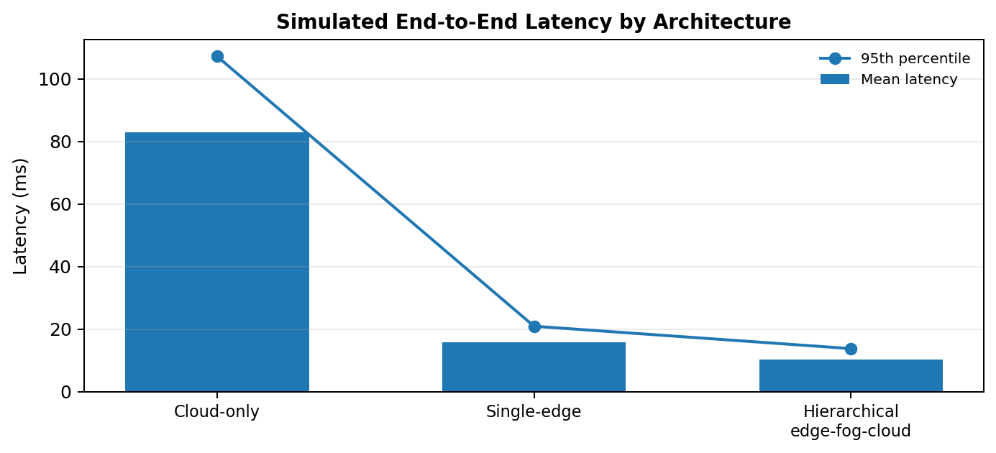
Industrial automation increasingly connects sensors, programmable logic controllers (PLCs), robots, vision systems, and enterprise services. A cloud-only architecture provides elastic computation but can introduce network delay, jitter, bandwidth consumption, and dependence on wide-area connectivity. Edge and fog computing move selected processing closer to machines and therefore offer a promising architecture for latency-sensitive industrial applications. This paper presents a simulation-based methodology for evaluating three deployment alternatives: cloud-only processing, a single-edge gateway, and a hierarchical edge-fog-cloud architecture. The study uses an identical workload of 30,000 industrial request-response transactions and evaluates mean end-to-end latency, 95th-percentile latency, jitter, success under a 50 ms control deadline, transaction availability, and the proportion of traffic forwarded over the wide-area network (WAN). The simulation indicates that the single-edge architecture reduces mean latency from 82.98 ms to 15.85 ms, while the hierarchical architecture reduces it to 10.43 ms. WAN traffic is reduced to 34% and 18% of the cloud-only baseline, respectively. The findings support the use of localized processing for time-sensitive automation while retaining cloud services for long-term analytics, model management, and enterprise integration. Because the evaluation is simulation-based, the numerical results should be interpreted as reproducible comparative evidence under the stated assumptions rather than as measurements from a particular factory.