Blockchain-Based Secure Data Sharing Framework for Internet of Things Applications
Keywords:
Abstract
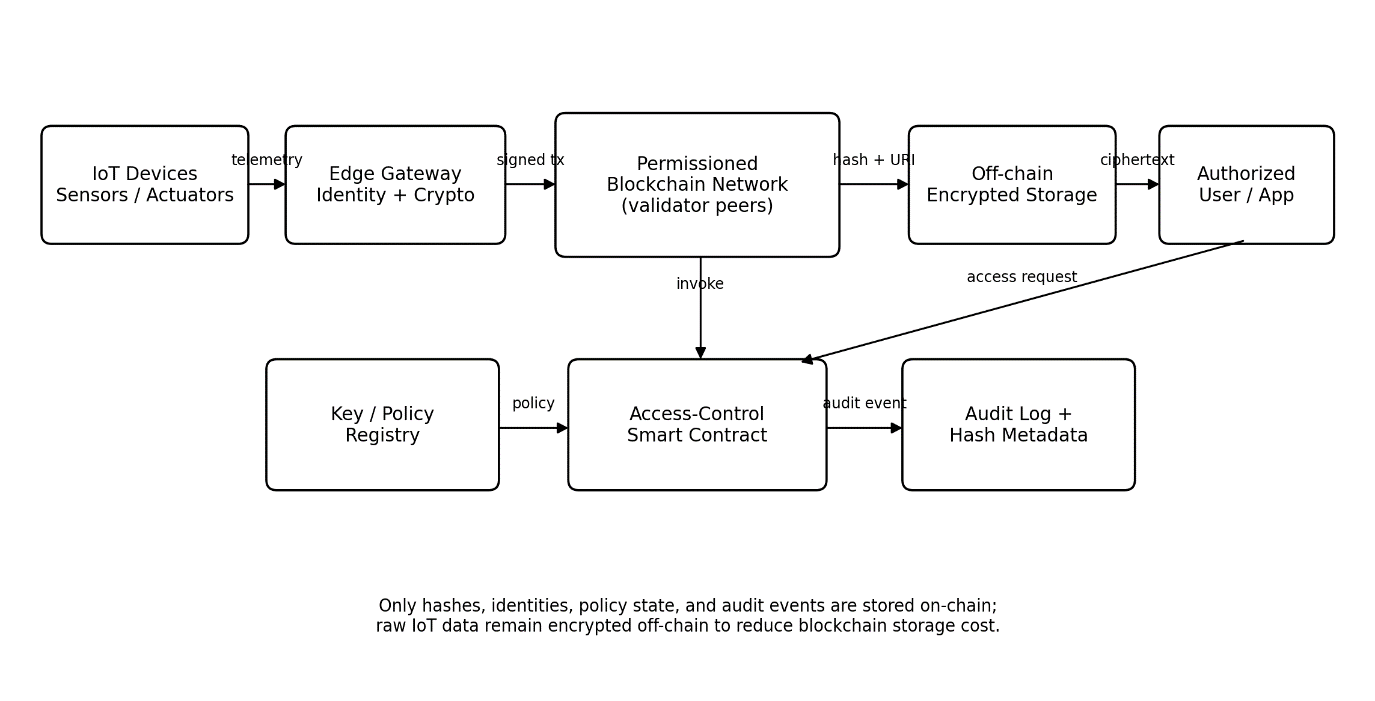
The Internet of Things (IoT) enables large numbers of heterogeneous devices to collect and exchange operational, environmental, and personal data, but conventional cloud-centered sharing models create concentrated points of trust and failure. This paper presents a methodology for a blockchain-based secure data sharing framework designed for IoT applications while respecting the computational limits of edge devices. The framework separates data from trust management: IoT payloads are encrypted and stored off-chain, whereas hashes, ownership records, access policies, and audit events are committed to a lightweight permissioned blockchain. An edge gateway performs device authentication, digital signing, encryption, and transaction submission so that constrained sensors are not required to maintain the ledger. A smart-contract layer evaluates access requests using subject, resource, operation, and time constraints and creates an immutable authorization trail. The methodology defines the architecture, transaction sequence, threat model, cryptographic controls, prototype assumptions, and evaluation metrics. A reproducible illustrative simulation is used to compare the proposed method with a conventional centralized access-control baseline in terms of tamper detection, access-decision latency, and service continuity under a single infrastructure failure. The simulated results show that the blockchain design adds validation latency but provides deterministic detection of modified audit records and avoids dependence on one authorization server. The study therefore supports a hybrid design in which blockchain is used for decentralized trust, policy enforcement, and accountability, while bulk sensor data remain outside the chain. The work is positioned against IoT and blockchain research published up to 2017 and identifies scalability, key management, metadata privacy, and validator governance as the principal issues for further empirical study.