Design and Implementation of a Smart Home Automation System Using Wireless Sensor Networks
Keywords:
Abstract
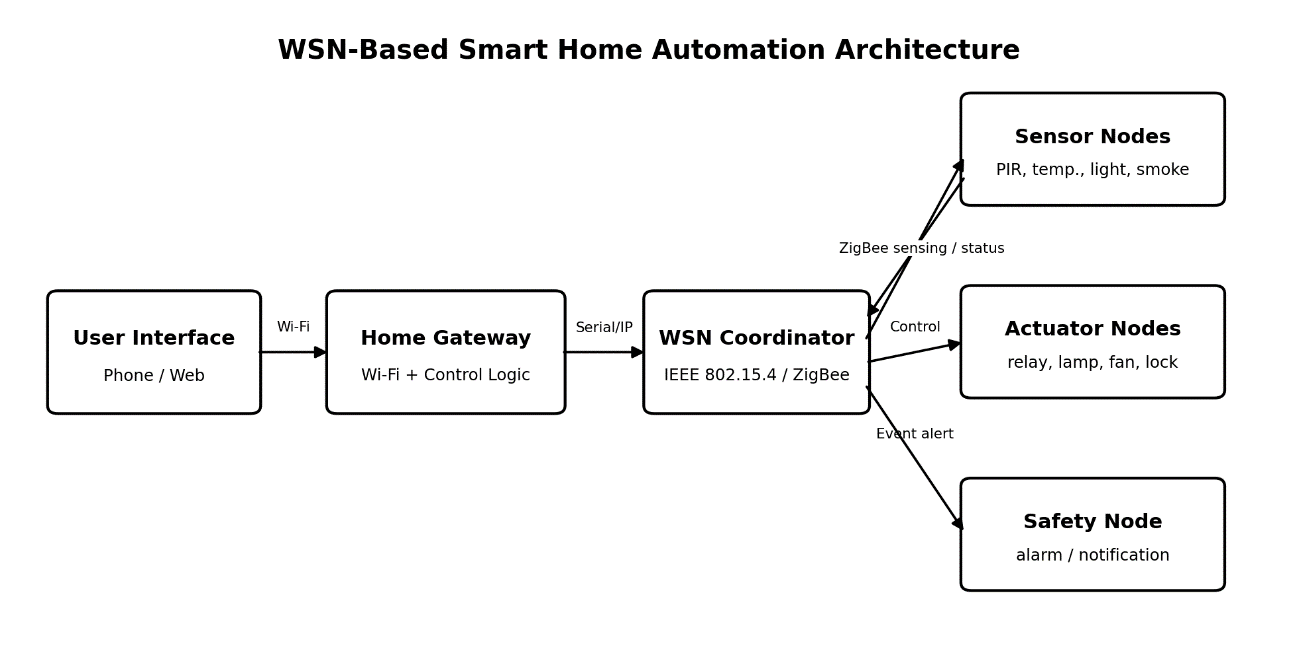
Smart home automation combines sensing, communication, computation, and actuation to improve comfort, safety, energy efficiency, and remote accessibility. This methodology paper presents the design and implementation framework of a wireless-sensor-network-based smart home system using low-power IEEE 802.15.4/ZigBee nodes, a home gateway, environmental and safety sensors, and relay-driven actuators. The proposed architecture follows a layered approach: distributed sensor nodes acquire temperature, illumination, motion, and smoke information; a ZigBee coordinator aggregates data; gateway software applies event rules and exposes local or remote user control; and actuator nodes execute commands for lighting, ventilation, access, and alarms. The design emphasizes low energy consumption, modularity, short response time, reliability, and basic security. A controlled simulation/prototype evaluation is defined to measure packet delivery ratio, command success rate, end-to-end latency, and node energy consumption. Representative evaluation results show that a small indoor network can maintain packet delivery above 97%, command success above 98%, and sub-second automation latency under normal household traffic. The methodology is suitable for low-cost residential automation and can be extended with stronger authentication, adaptive energy management, and Internet of Things integration.