A Comparative Analysis of Routing Protocols in Mobile Ad Hoc Networks (MANETs)
DOI:
https://doi.org/10.65521/ijacect.v5i1.4151Keywords:
Abstract
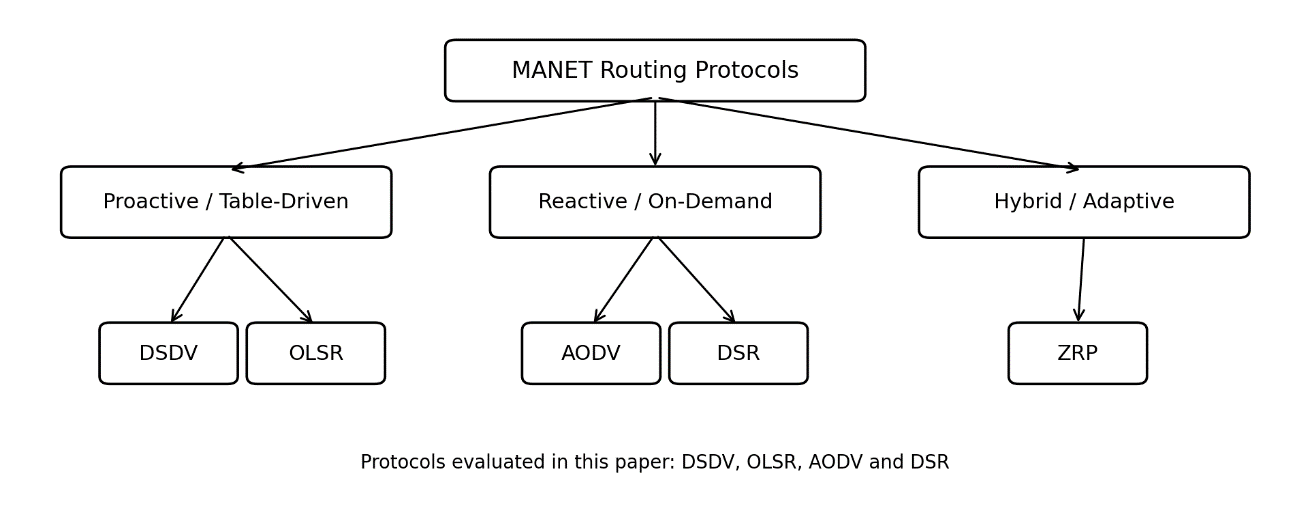
Mobile Ad Hoc Networks (MANETs) provide infrastructureless, self-organizing wireless communication in which every mobile node may act simultaneously as a host and as a router. Their usefulness in emergency response, military coordination, temporary events, vehicular or field communication, and rapidly deployed sensor-rich environments is accompanied by a difficult routing problem: links appear and disappear as nodes move, bandwidth is scarce, and route maintenance consumes the same wireless medium used by application traffic. This methodology paper develops a controlled comparative framework for four representative MANET routing protocols: Destination-Sequenced Distance-Vector (DSDV), Optimized Link State Routing (OLSR), Ad Hoc On-Demand Distance Vector (AODV), and Dynamic Source Routing (DSR). The protocols cover the two dominant design families, proactive and reactive routing. A Network Simulator-2 (NS-2) based experimental design is specified using an IEEE 802.11 wireless model, random waypoint mobility, constant-bit-rate traffic, and repeated runs under varying mobility and node density. Packet delivery ratio, average end-to-end delay, throughput, and normalized routing load are selected as performance measures. The literature-guided comparison indicates that proactive protocols can provide low route-acquisition delay when topology changes are moderate, while reactive protocols reduce periodic routing overhead and often adapt better when routes are used intermittently. AODV offers a strong balance between delivery and control cost under changing topology; DSR is efficient in smaller networks but source-route headers and cache staleness can become costly at scale; DSDV offers predictable table-driven forwarding but incurs periodic update cost; and OLSR benefits dense networks through multipoint relays. The study therefore emphasizes that no single MANET routing protocol is universally optimal; protocol choice should be tied to mobility, network density, traffic intensity, and delay requirements