Design and Performance Analysis of Energy-Efficient Routing Protocols in Wireless Sensor Networks
Keywords:
Abstract
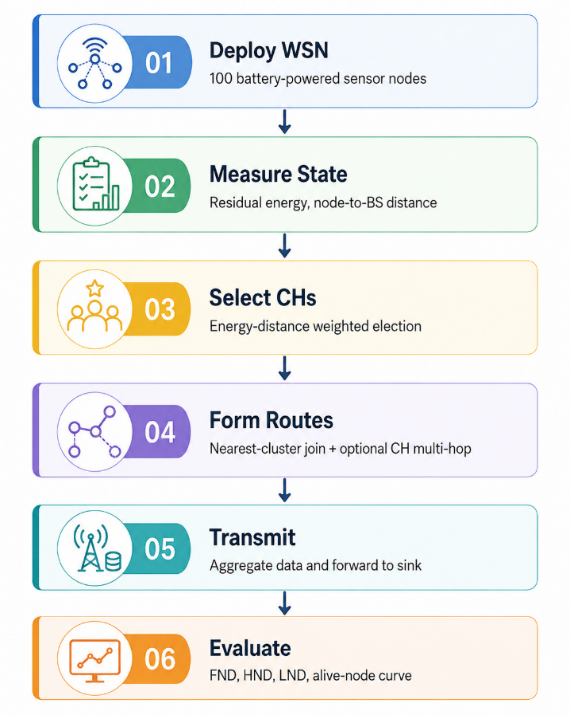
Wireless sensor networks (WSNs) are composed of battery-constrained sensing devices whose operational lifetime is strongly affected by communication energy. This methodology paper develops a reproducible framework for the design and performance analysis of energy-efficient routing approaches, using literature published no later than 2015. The study reviews classical data-centric, clustering, and chain-based mechanisms and then formulates a residual-energy and distance-aware multi-hop (REDA-MH) routing design for comparison with direct transmission, LEACH-like clustering, and a PEGASIS-inspired chain. A first-order radio-energy model is used to account for transmitter, receiver, data-aggregation, and distance-dependent amplifier costs. Performance is evaluated through first-node-death (FND), half-node-death (HND), last-node-death (LND), and alive-node curves under a common 100-node deployment. The illustrative simulation shows that no single routing strategy dominates all lifetime measures: energy-aware clustering substantially improves the stable operating period, while chain-based routing can preserve a longer late-stage tail. The proposed REDA-MH design produces the largest FND in the tested scenario, demonstrating the value of residual-energy balancing when stable sensing coverage is the main objective.