
AI-Driven Tuberculosis Detection: A Review of Machine Learning and Deep Learning Approaches
Keywords:
Abstract
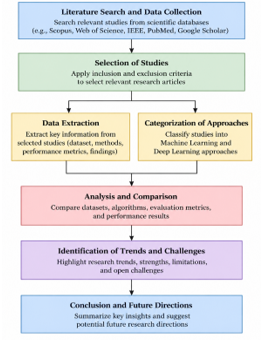
Tuberculosis (TB) remains one of the major infectious diseases worldwide, and early detection is essential for timely treatment and reducing disease transmission. Conventional TB diagnosis can be challenging in regions with limited access to trained healthcare professionals, advanced laboratory facilities, and specialized radiological expertise. The rapid development of Artificial Intelligence (AI), particularly Machine Learning (ML) and Deep Learning (DL), has created new opportunities for automated and computer-assisted TB detection. Among various diagnostic modalities, chest X-ray (CXR) imaging has received significant attention because of its widespread availability and important role in pulmonary TB screening. This paper presents a review and methodological framework for AI-driven tuberculosis detection using ML and DL techniques. Conventional ML algorithms, including Support Vector Machine (SVM), Random Forest (RF), and k-Nearest Neighbors (KNN), are reviewed alongside DL architectures such as Convolutional Neural Networks (CNN), VGG, Res Net, Dense Net, and transfer-learning-based models. The proposed methodology includes data acquisition, preprocessing, image augmentation, feature extraction, model training, classification, explainable AI, and performance evaluation. In addition, emerging cough-audio-based AI approaches are considered as a complementary non-invasive screening modality.
Downloads
Published
How to Cite
Issue
Section
License

This work is licensed under a Creative Commons Attribution-NoDerivatives 4.0 International License.
