Optimized Deep Transfer Learning Based Detection and Diagnosis of Parkinson's Disease
Keywords:
Abstract
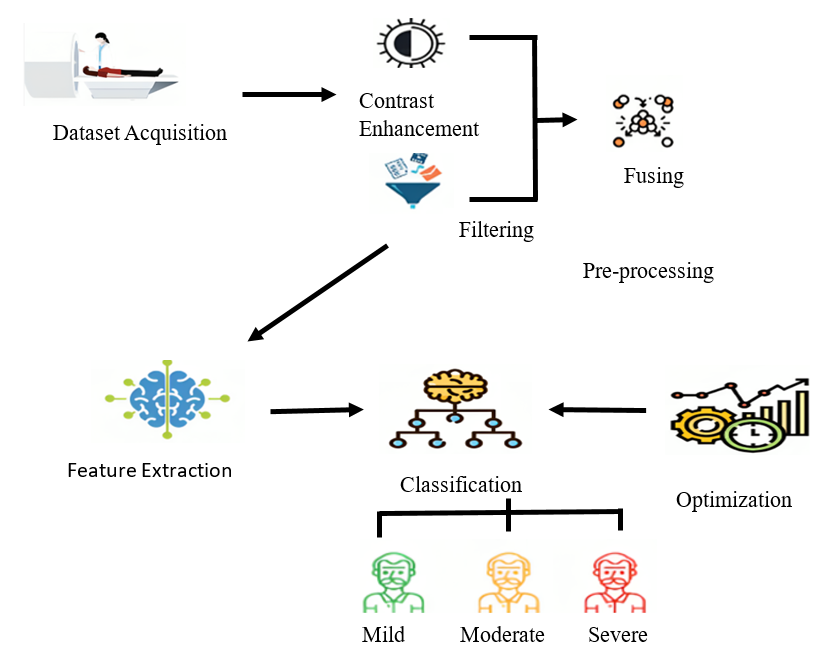
The symptoms of Parkinson's disease (PD), a chronic neurological condition, are similar to those of other illnesses and advance slowly. It is essential to diagnose Parkinson's disease (PD) early in order to provide the right medication for patients to lead healthy, productive lives. In addition to various mental symptoms, the disease is characterised by tremors, muscle rigidity, slowness in movements, and abnormalities in balance. One of the primary factors that facilitate PD detection and evaluation is the dynamics of handwritten documents. For the early detection of this illness, a number of machine learning techniques have been studied. The majority of these manually developed feature extraction methods, however, primarily struggle with poor performance accuracy. When dealing with the discovery of a chronic illness like this, this cannot be tolerated. An effective deep learning model is therefore put out, which can help with Parkinson's disease early diagnosis. The suggested model's key contribution is its ability to choose the best features, which results in high performance accuracy. The K-Nearest Neighbour approach is used in a genetic algorithm to optimise the features. The suggested innovative model yields an area under the curve of 0.90 with a loss of 0.12 only, a detection accuracy of over 95%, and a precision of 98%. The superior detection capabilities of our model is demonstrated by comparing its performance with some cutting-edge machine learning and deep learning-based PD detection techniques.