
AI-Based Research Assistant using Crew AI
DOI:
https://doi.org/10.65521/ijacect.v15i1.2570Keywords:
Abstract
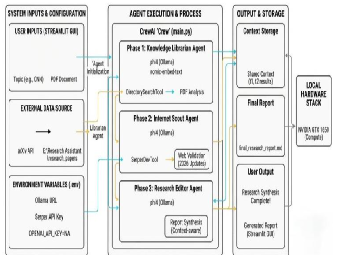
In today’s pressurizing academic calendar the exponential growth of scientific literature has created a “knowledge bottleneck”, where researchers struggle to stay with current and rapidly evolving technical domains this project presents the “Jarvis Protocol” an autonomous multi-agent research system engineered using the Crewai framework. Unlike traditional cloud-based ai tools that requires high operational costs and develops high data privacy risks, this system is designed for 100% local execution on consumer-grade hardware, specifically optimized for the NVIDIA GTX 1650 (4GB-6GB VRAM). The architecture works on a hierarchical team of specialized agents ‘the knowledge librarian’, ‘internet scout’ and ‘research editor’ it performs complex end-to-end research workflows by using a local Chroma DB vector vault with nomic-embed-text and leveraging the Ollama inference engine. The system achieves deep semantic analysis of proprietary pdfs and real-time web validation without external API dependencies. Key innovations include a source-anchoring mandate to eliminate hallucinations and a custom embedding configuration that bypasses paid OpenAI services through an “NA” dummy key workaround. Experimental results shows that the Jarvis protocol provides a secure zero-cost and high-optimal environment for academic inquiry delivering comprehensive formatted markdown reports that are fully traceable to their original sources. This project proves the feasibility of Sovereign ai offering a scalable blueprint for researchers and enterprises to harness agentic intelligence while maintaining absolute data sovereignty.
Downloads
Published
How to Cite
Issue
Section
License

This work is licensed under a Creative Commons Attribution-NoDerivatives 4.0 International License.
