Development of an Automatic Street Lighting System Using Embedded Controllers
DOI:
https://doi.org/10.65521/itsi-teee.v8i1.4220Keywords:
Abstract
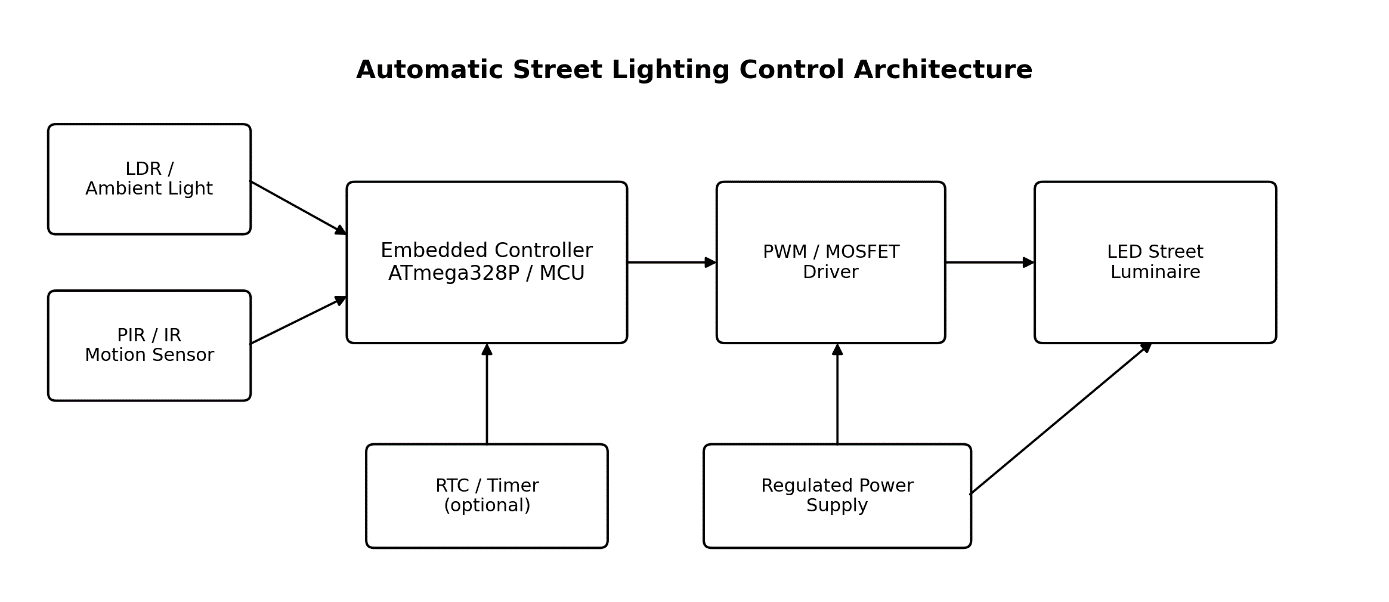
Conventional street-lighting installations commonly operate at full output throughout the night, even when daylight is sufficient or road activity is low. This methodology paper develops a low-cost automatic street-lighting architecture centered on an embedded microcontroller, an ambient-light sensor, a motion sensor, and a pulse-width-modulated LED driver. The controller first determines whether the environment is dark enough to require lighting; after dusk, it maintains a reduced illumination level during low activity and raises selected luminaires to full output when pedestrian or vehicle motion is detected. The proposed design emphasizes local autonomous operation, short response time, low component count, and compatibility with later networked monitoring. A design-case evaluation is formulated for ten 20 W LED luminaires operating for a 12 h night period. Using stated traffic and dimming assumptions, the controller reduces calculated nightly energy use from 2.40 kWh for conventional full-output operation to approximately 1.48 kWh, corresponding to an estimated energy saving of 38.5%. The methodology provides a reproducible sequence for sensor calibration, controller logic development, driver integration, safety verification, and performance estimation. The design is intended as a practical foundation for campus roads, residential streets, parking areas, and other low-to-medium traffic applications