Deep Learning and Optimization Approaches in Parkinson’s Disease Recognition from EEG Using Attention-Based Sparse Graph Convolutional Neural Networks: A Review
DOI:
https://doi.org/10.65521/itsi-teee.v13i2.3859Keywords:
Abstract
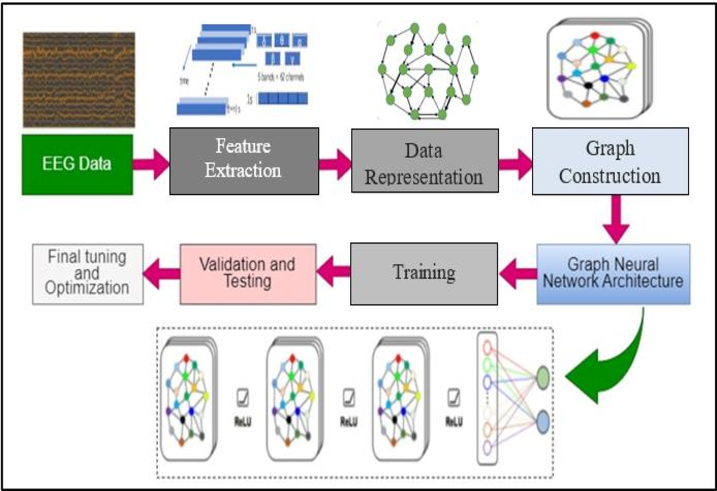
Parkinson’s disease (PD) is a progressive neurodegenerative disorder characterized by motor and cognitive impairments, making early diagnosis critical for effective treatment. Electroencephalogram (EEG) signals have emerged as a promising non-invasive tool for detecting neurological abnormalities associated with PD. However, traditional diagnostic approaches relying on handcrafted features often fail to capture complex spatial and functional relationships in brain activity.Recent advancements in deep learning (DL) have significantly improved EEG-based PD recognition by enabling automated feature extraction and classification. Convolutional Neural Networks (CNNs), Recurrent Neural Networks (RNNs), and hybrid architectures have demonstrated notable performance improvements. However, these models are limited in capturing non-Euclidean relationships among EEG channels. Graph Convolutional Networks (GCNs) address this limitation by modeling EEG signals as graph structures, effectively capturing spatial connectivity. Furthermore, attention mechanisms and sparsity constraints enhance model interpretability and efficiency by focusing on relevant brain regions and eliminating redundant connections. Attention-based Sparse Graph Convolutional Neural Networks (ASGCNN) have shown promising results in improving classification accuracy and robustness.
This review provides a comprehensive analysis of deep learning and optimization techniques for EEG-based PD recognition, highlighting recent trends, comparative performance, challenges, and future research directions.