AI-Based Deep Capsule Attention Network for Breast Cancer Molecular Subtype Prediction Using Mammograms
DOI:
https://doi.org/10.65521/itsi-teee.v14i2.2840Keywords:
Abstract
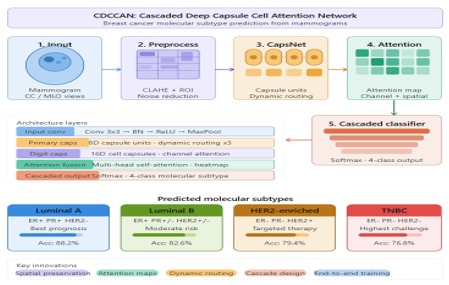
Breast cancer remains one of the most prevalent and life-threatening malignancies affecting women globally, with early and accurate molecular subtype classification being critical to effective treatment planning. Traditional diagnostic methods, including histopathological analysis and immunohistochemistry, are time-consuming, costly, and subject to inter-observer variability. The advent of artificial intelligence (AI), particularly deep learning-based frameworks, has opened transformative possibilities for automated, non-invasive breast cancer subtype prediction from mammogram images. This paper presents a comprehensive review of AI techniques with a focus on Cascaded Deep Capsule Cell Attention Network (CDCCAN) models for predicting breast cancer molecular subtypes — Luminal A, Luminal B, HER2-enriched, and Triple-Negative Breast Cancer (TNBC) — using mammographic imaging. The proposed conceptual framework integrates capsule networks, multi-scale attention mechanisms, and cascaded deep learning architectures to address limitations of conventional convolutional neural networks, including spatial invariance loss and poor generalization. A structured literature review of 30 studies published in recent years is synthesized, highlighting key trends, benchmark datasets, performance metrics, and persistent challenges including data imbalance, model interpretability, and clinical integration. The paper concludes by identifying future research directions toward robust, explainable, and clinically deployable AI systems for breast cancer diagnosis.