
Digital Payment Adoption among Agricultural Produce Street Vendors: An Empirical Study in Kalaburagi District, Karnataka
DOI:
https://doi.org/10.65521/ijrdmr.v15i1.1672Keywords:
Abstract
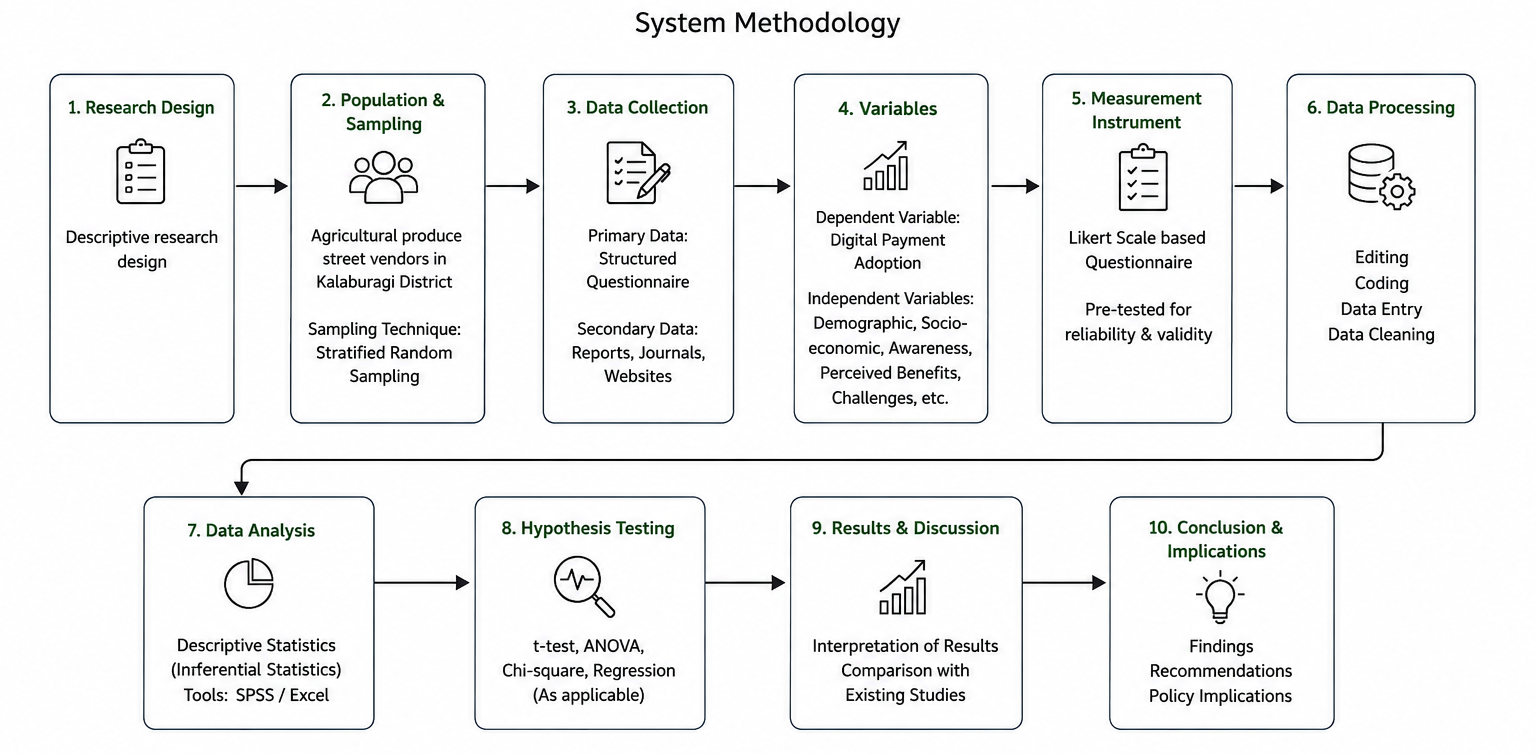
Purpose: This study investigates digital payment adoption patterns, determinants, and impacts on agricultural produce street vendors in Kalaburagi district, Karnataka, examining the intersection of agricultural marketing and financial technology. Design/Methodology/Approach: Primary data were collected from 200 agricultural produce vendors through structured questionnaires using stratified random sampling. Descriptive statistics, chi-square tests, Pearson correlation, and multiple regression analysis were employed. Findings: Results reveal 58% adoption rate among agricultural vendors, significantly lower than general merchandise vendors. Fresh produce vendors (41.5%) showed substantially lower adoption than processed agricultural products (71.4%). Perishability concerns (67.8%) and seasonal income fluctuations (β=-0.412, p<0.01) emerged as unique barriers. However, 54.3% of adopters reported reduced post-harvest losses through faster transactions. Educational qualification (χ²=28.34, p<0.01) and cold storage access (OR=2.87, p<0.05) significantly influenced adoption. Research Limitations: Geographic specificity and cross-sectional design limit generalizability and causal inferences. Practical Implications: Findings inform agricultural marketing policies emphasizing value chain-specific digital solutions, cold chain infrastructure integration, and seasonal pricing models for agricultural vendors. Originality/Value: This research uniquely examines digital financial inclusion at the agriculture-urban retail interface, addressing gaps in agricultural marketing and technology adoption literature.
Downloads
Downloads
Published
How to Cite
Issue
Section
License

This work is licensed under a Creative Commons Attribution-NoDerivatives 4.0 International License.
