
Connectivity-Aware Reactive Path Planning for Small Multi-UAV Teams: A Reproducible Simulation Study with Fair Baselines and Link-Level Evaluation
Keywords:
Abstract
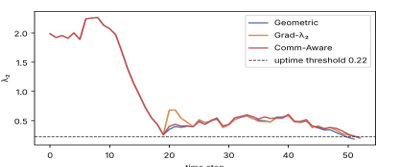
Small UAV teams must reach individual goals while keeping their radio network connected. This paper asks how much a lightweight, reactive correction that protects the algebraic connectivity λ₂ of the communication graph can add to a standard potential-field controller. Five controllers are compared on identical random scenarios: a geometric potential-field controller, a rigid-formation controller, an always-on cohesion controller, a Fiedler-vector gradient controller (Grad-λ₂), and the communication-aware (CA) controller, which blends goal and neighbour-centroid directions when predicted λ₂ falls below a threshold. All controllers share the same obstacle and inter-UAV repulsion, so differences are attributable to the connectivity logic alone. Each cell uses 100 paired Monte-Carlo runs, with Wilson and t-based confidence intervals and Holm-corrected paired tests. With a 40 m communication threshold, connectivity is never the binding constraint and the controllers are statistically indistinguishable. In a stressed regime (22 m threshold, dispersed goals, velocity noise) the CA controller raises connectivity uptime from 0.634 to 0.727 (paired p < 0.001) and the minimum λ₂ from 0.05 to 0.07,
at a cost of 0.5 m extra path, but its success-rate gain (0.55 vs 0.48) is not significant after multiplicity correction, and it does not reduce inter-UAV proximity events (4.9 vs 5.0). The Grad-λ₂ baseline outperforms CA (uptime 0.815, success 0.69). An earlier reported 45-fold reduction in proximity events is traced to an asymmetry in inter-UAV repulsion, not to the connectivity term: removing repulsion raises proximity events about tenfold for every controller. A post-hoc SNR-based link evaluation, measured runtimes, and an explicit list of limitations are provided. Code and raw per-run data are released.
Downloads
Published
How to Cite
Issue
Section
License

This work is licensed under a Creative Commons Attribution-NoDerivatives 4.0 International License.