Efficient Medical Image Classification Using Masked Attention Networks
Keywords:
Abstract
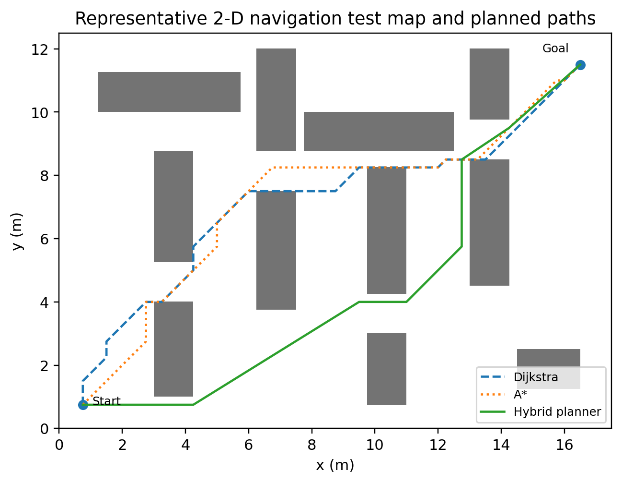
Autonomous mobile robots require a navigation system that can perceive the environment, estimate pose, generate a collision-free route, react to previously unseen obstacles, and convert the planned path into dynamically feasible motion. This methodology paper develops a reproducible framework for studying intelligent path planning and navigation by combining a grid-based global planner, path smoothing, local velocity-based obstacle avoidance, and feedback re-planning. The literature is restricted to work published in 2021 or earlier and spans classical graph search, artificial potential fields, sampling-based motion planning, dynamic window navigation, particle-swarm-based smoothing, and deep reinforcement learning. The proposed experimental protocol uses a differential-drive robot model and a two-dimensional occupancy-cost map. Dijkstra, A*, and a hybrid weighted A* plus smoothing strategy are evaluated under identical map conditions using path length, planning time, expanded nodes, number of heading changes, clearance, and navigation success as performance indicators. A deterministic simulation included with this paper demonstrates that heuristic guidance substantially reduces search effort, while the hybrid planner reduces unnecessary turns and produces a smoother reference path. The methodology is intended as a compact baseline for subsequent implementation in ROS/Gazebo or on a physical autonomous mobile robot.