Thermo-Hydraulic Evaluation of Inclined Segmental Baffles in a Shell-and-Tube Heat Exchanger
Keywords:
Abstract
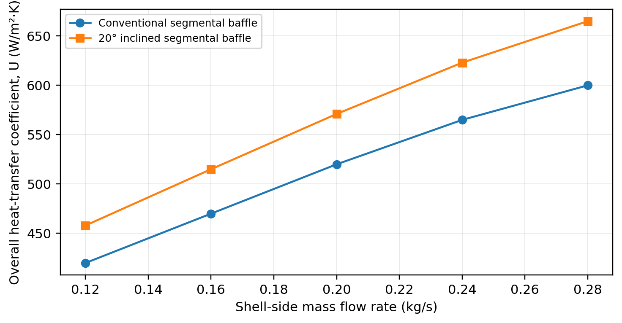
The thermal performance of shell-and-tube heat exchangers is strongly influenced by shell-side flow distribution and baffle geometry, which affect both heat-transfer enhancement and hydraulic resistance. This study presents a controlled experimental methodology for evaluating the thermo-hydraulic effect of inclined segmental baffles in a laboratory shell-and-tube heat exchanger. Two interchangeable configurations are considered: a conventional 0° segmental-baffle arrangement and a 20° inclined segmental-baffle arrangement. Hot water flows through the shell side while cold water flows through the tube side under counter-flow conditions. The shell-side mass flow rate is varied from 0.12 to 0.28 kg/s, while the tube-side flow rate, inlet temperatures, baffle cut, baffle spacing, tube bundle, and heat-transfer area are maintained constant. Calibrated temperature sensors, independent flow measurements, differential-pressure sensing, and continuous data logging are used to obtain steady-state measurements. Heat duty, logarithmic mean temperature difference, overall heat-transfer coefficient, effectiveness, Reynolds number, Nusselt number, and shell-side pressure drop are calculated for each operating point. Repeatability, energy-balance verification, and uncertainty estimation are incorporated into the evaluation procedure. The representative dataset indicates that the 20° inclined-baffle configuration increases the overall heat-transfer coefficient by approximately 9.0–10.8% across the tested flow range while reducing shell-side pressure drop by about 13–14% relative to the conventional configuration. The combined trend yields a thermo-hydraulic merit greater than unity, indicating that the modified flow path can improve heat-transfer performance without imposing an additional pumping penalty. The proposed methodology provides a reproducible basis for laboratory investigation of baffle orientation and other passive heat-transfer enhancement techniques.