Performance Evaluation of Hybrid Electric Vehicle Powertrain Systems
Keywords:
Abstract
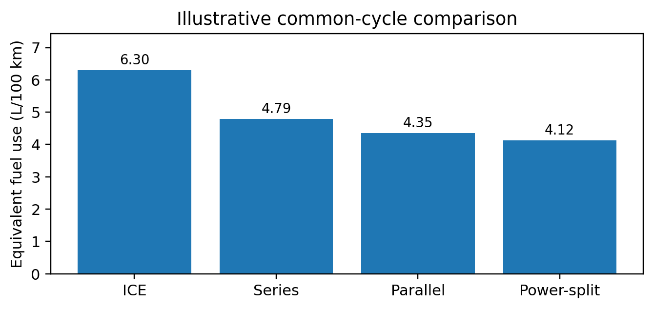
Hybrid electric vehicle (HEV) performance depends on the interaction of powertrain topology, component efficiency, regenerative braking, battery utilization, and supervisory energy management. This paper presents a compact and reproducible methodology for evaluating series, parallel, and power-split HEV powertrains under identical driving demand. The method combines a longitudinal vehicle model with quasi-static energy conversion models, a charge-sustaining supervisory control layer, and common key performance indicators covering equivalent fuel consumption, regenerative energy recovery, cycle-level fuel-to-wheel efficiency, traction capability, and battery state-of-charge constraints. A representative 1500 s urban-highway composite profile is used only as an illustrative case study; it is not presented as regulatory or experimental test data. Under the stated assumptions, the illustrative power-split system produced the lowest equivalent fuel use, followed by the parallel and series configurations. The main contribution is not a claim of vehicle certification performance, but a step-by-step evaluation framework that can be implemented in MATLAB/Simulink, ADVISOR, AVL Cruise, GT-SUITE, or an equivalent simulation environment and subsequently validated using chassis-dynamometer or on-road measurements.