Energy-Efficient Design and Control of HVAC Systems for Smart Buildings
Keywords:
Abstract
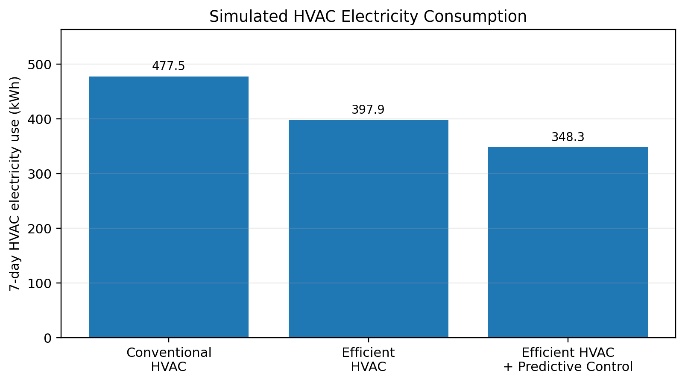
Heating, ventilation and air-conditioning (HVAC) systems are a dominant controllable load in smart buildings, and their efficiency depends on both equipment design and supervisory control. This methodology paper develops an integrated framework that combines high-efficiency variable-speed HVAC equipment, Internet-of-Things sensing, occupancy information, weather forecasts, a reduced-order thermal model and model predictive control (MPC). The proposed method is evaluated through a reproducible seven-day summer simulation of a representative single-zone smart office. Three cases are compared: a conventional fixed-setpoint proportional controller with coefficient of performance (COP) 3.0, a higher-efficiency variable-speed HVAC system with COP 3.6 under the same control logic, and the efficient system supervised by an eight-hour receding-horizon predictive controller. The simulated framework maintains occupied-zone temperature within 23–25 °C while minimizing electricity use and actuator effort. The high-efficiency equipment case reduces electricity use from 477.5 to 397.9 kWh (16.7%), while predictive control further reduces it to 348.3 kWh, corresponding to a 27.1% reduction relative to the conventional case. Peak electrical demand falls by approximately 14.5% in the integrated design-control case. The results support a practical research methodology in which sensing, control-oriented modeling and equipment efficiency are co-designed rather than optimized independently.