CFD Analysis of Aerodynamic Performance in Unmanned Aerial Vehicles
Keywords:
Abstract
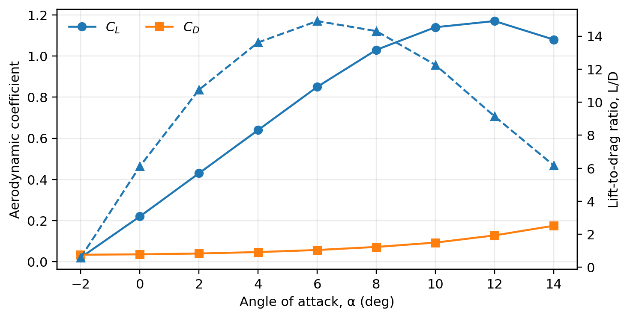
Computational fluid dynamics (CFD) provides a practical route for evaluating unmanned aerial vehicle (UAV) aerodynamics before costly prototype and wind-tunnel campaigns. This methodology paper presents a reproducible CFD procedure for a small fixed-wing UAV operating in the low-subsonic, low-to-moderate Reynolds-number regime. The procedure integrates geometry preparation, domain construction, grid refinement, transition-sensitive Reynolds-averaged Navier-Stokes (RANS) modeling, boundary-condition definition, convergence monitoring, and aerodynamic post-processing. A representative UAV with a 2.0 m span, 0.65 m² reference area and 0.325 m mean aerodynamic chord is considered at 15 m/s, corresponding to a chord Reynolds number of approximately 3.3×10^5 at sea-level conditions. The SST k-ω framework is adopted because of its established performance in wall-bounded aerodynamic flows, while the γ-Reθ transition formulation is recommended where laminar separation and transition influence low-Reynolds-number drag. Grid independence is assessed using successive mesh levels and the lift, drag and pitching-moment coefficients are monitored as primary integral quantities. Demonstrative results generated for the defined notional case show the expected increase of lift with angle of attack, a rapid drag rise near stall, and a maximum lift-to-drag ratio in the moderate-angle range. The workflow is consistent with pre-2021 UAV and low-Reynolds-number aerodynamic literature and is intended as a compact methodology for preliminary design, configuration comparison and CFD verification studies.