Additive Manufacturing Techniques for Rapid Prototyping in Mechanical Engineering Applications
Keywords:
Abstract
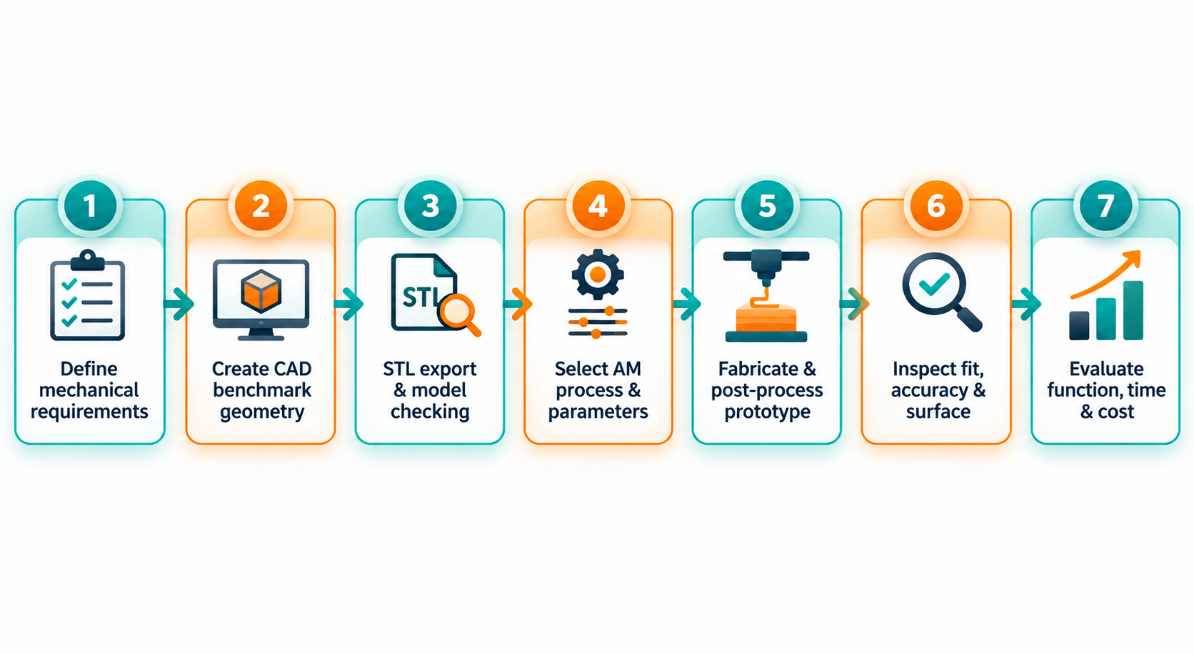
Additive manufacturing (AM) has transformed rapid prototyping by enabling mechanical engineers to convert digital models into physical components without dedicated tooling. This methodology paper develops a literature-grounded framework for selecting and evaluating AM techniques for rapid prototyping in mechanical engineering applications, with emphasis on fused deposition modeling/fused filament fabrication (FDM/FFF), stereolithography (SLA), and selective laser sintering (SLS). The proposed procedure integrates design requirements, CAD model preparation, tessellation and slicing, process and material selection, fabrication, post-processing, dimensional inspection, functional assessment, and multi-criteria comparison of quality, time, and cost. The framework is intended for concept models, fit-and-assembly prototypes, and functional engineering prototypes. Published work demonstrates that AM can shorten iteration cycles and enable geometries that are difficult to manufacture conventionally, although process-dependent anisotropy, surface finish, dimensional deviation, and material limitations remain important design constraints [1], [6], [9]. A qualitative synthesis shows that FDM is particularly attractive for economical concept and fit testing, SLA is preferred where surface finish and geometric detail dominate, and SLS is advantageous for complex functional polymer prototypes because surrounding powder reduces support-structure constraints. The study provides a reproducible decision pathway that can be adapted to laboratory testing or industrial prototype development while restricting the supporting literature to publications available through 2019.