Finite Element Analysis of Composite Materials for Lightweight Mechanical Structures
Keywords:
Abstract
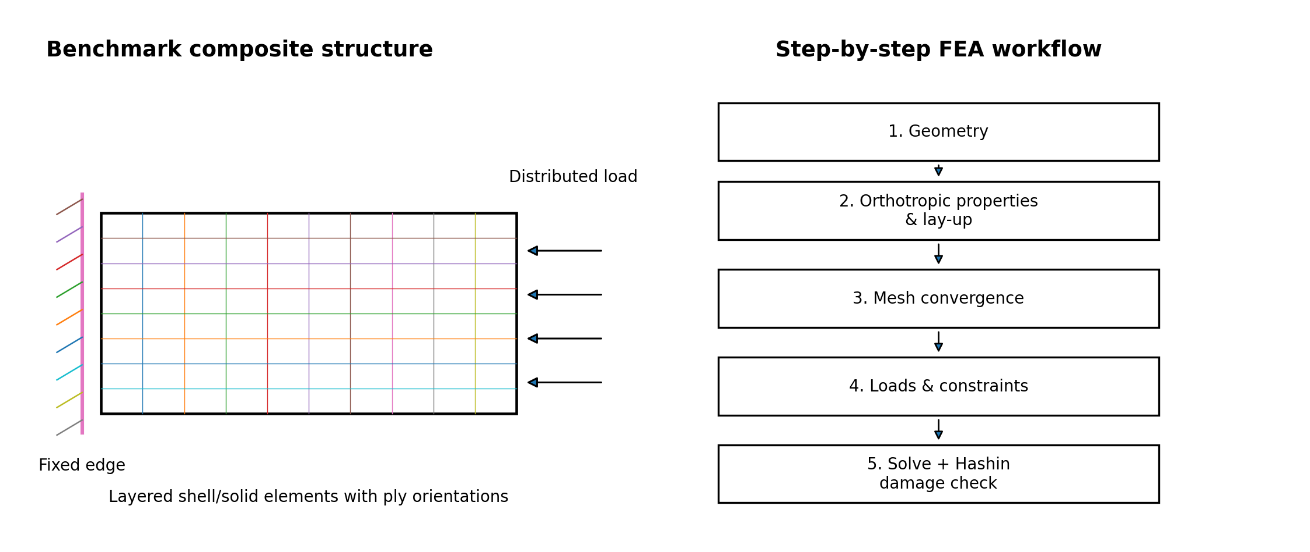
Composite materials offer high specific stiffness and strength, making them attractive for lightweight mechanical structures in automotive, aerospace, robotic, and general machine-design applications. Their directional properties and multiple failure modes, however, make conventional isotropic design assumptions inadequate. This methodology paper presents a finite element analysis (FEA) framework for evaluating laminated fibre-reinforced polymer structures under static mechanical loading. The procedure combines orthotropic lamina properties, classical laminate lay-up definition, mesh-convergence assessment, realistic boundary conditions, ply-level stress recovery, and Hashin-type failure indices. A rectangular cantilever structural panel is adopted as a reproducible benchmark for comparing candidate carbon-fibre/epoxy stacking sequences with a steel reference of identical geometry. The numerical workflow is designed to quantify mass, deformation, stress distribution, and damage initiation while supporting laminate tailoring for minimum weight. Representative benchmark outputs indicate that a fibre-dominated lay-up can substantially reduce structural mass while retaining acceptable stiffness and a failure index below unity. Because no laboratory dataset is supplied, the reported numerical values are illustrative outputs for the proposed benchmark and should be replaced by solver-generated results and experimental validation in an application-specific study. The paper emphasizes mesh independence, material-coordinate definition, failure-criterion selection, and transparent reporting as essential requirements for reliable composite FEA.