Experimental Investigation of Heat Transfer Enhancement Using Nanofluids in Heat Exchangers
Keywords:
Abstract
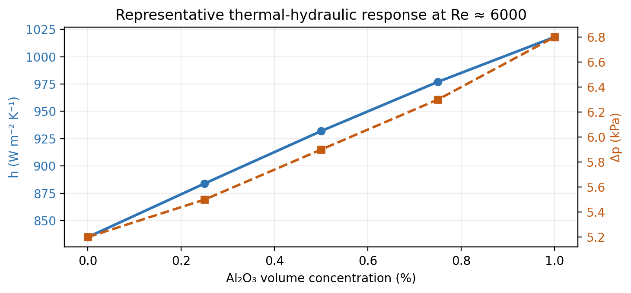
This paper presents a repeatable experimental methodology for quantifying heat-transfer enhancement and hydraulic penalty when water is replaced by Al₂O₃-water nanofluid in a counter-flow double-pipe heat exchanger. Stable suspensions at 0.25-1.00 vol% are proposed, with inlet temperature, flow rate and exchanger geometry controlled while outlet temperatures and pressure drop are measured. Heat duty, log-mean temperature difference, overall and convective heat-transfer coefficients, Nusselt number, friction factor and a performance evaluation criterion are calculated from an energy balance. A representative dataset shows the convective coefficient increasing from 835 W m⁻² K⁻¹ for water to 1,018 W m⁻² K⁻¹ at 1.0 vol% (21.9%), while pressure drop rises from 5.2 to 6.8 kPa (30.8%). The results illustrate the expected concentration-dependent trade-off: improved thermal transport is accompanied by increased pumping demand. The methodology therefore evaluates enhancement on a thermo-hydraulic basis rather than heat transfer alone. The protocol includes stability checks, baseline validation, uncertainty propagation and repeat tests, making it suitable for an undergraduate laboratory or a scaled research rig.