Optimization of Cnc Machining Parameters for Improved Surface Finish and Productivity
Keywords:
Abstract
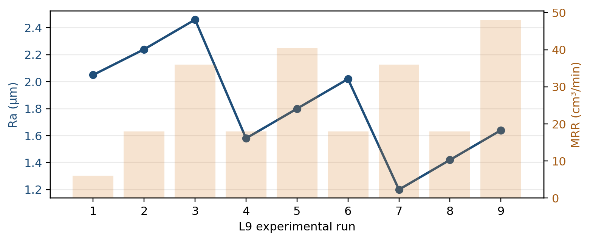
Computer numerical control (CNC) machining requires a controlled compromise between surface integrity and production rate. This methodology paper develops a reproducible multi-response procedure for selecting cutting speed, feed rate and depth of cut in CNC turning. A three-factor, three-level Taguchi L9 orthogonal array is combined with analysis of variance (ANOVA), regression modelling and grey relational analysis (GRA). Arithmetic average roughness (Ra) is minimized while material removal rate (MRR) is maximized. The procedure specifies workpiece preparation, tool control, randomized experimentation, profilometer measurement, response normalization and confirmation testing. A representative dataset illustrates how the method identifies a balanced setting of 240 m/min cutting speed, 0.10 mm/rev feed and 1.5 mm depth of cut. Relative to a conservative baseline, the illustrative optimum reduces Ra from 2.05 to 1.20 µm while increasing MRR from 6 to 36 cm³/min. These numerical results demonstrate the analysis workflow and must be replaced or validated by laboratory observations before publication as experimental findings. The method offers a low-cost framework for improving quality and throughput without relying on exhaustive trials.